Giant Precision
Quality assurance for large-scale castings
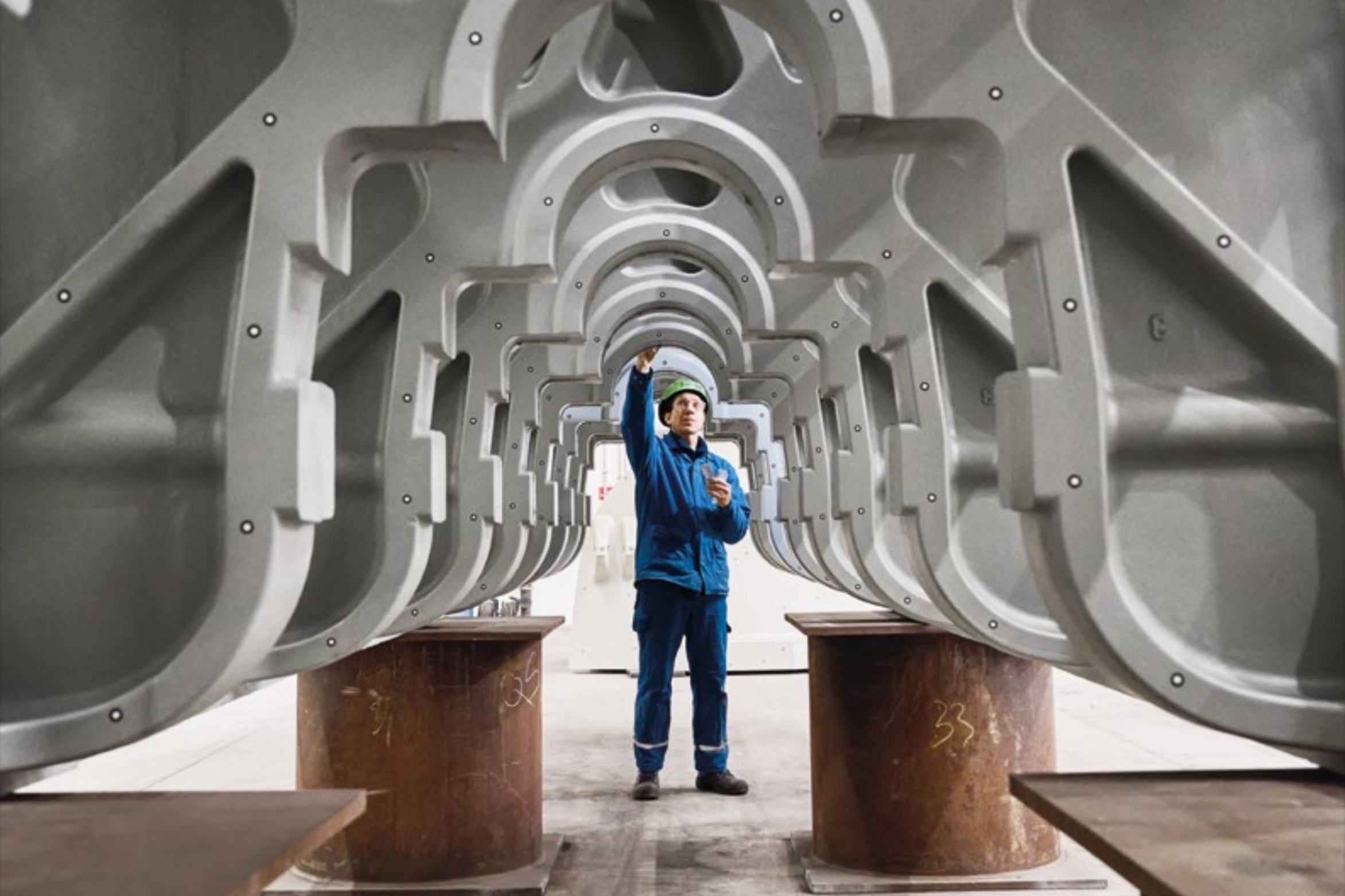
Large-scale castings are becoming more important across various industries, driven by the need for efficiency and cost-effectiveness in manufacturing. From shipbuilding to power generation, sectors are increasingly relying on oversized parts to meet their operational demands. A notable example of this trend is found in the automotive industry, where gigacasting is transforming the production of large aluminum parts. Instead of manufacturing different parts of a car body individually and then welding them together, large components are now manufactured from a single casting. This approach not only reduces production and personnel costs but also enhances overall efficiency. All that is needed is a large mold into which the liquid aluminum is shot under very high pressure. Handtmann, Europe’s largest light-metal foundry, is leading the transition to gigacasting by casting complete structural parts and battery trays for electric vehicles in one piece.
Handtmann Group
New standards in die casting
An example of the gigacasting megatrend can be seen in the large parts produced by die casting company Albert Handtmann
Metallgusswerk GmbH & Co. KG. Headquartered in Biberach, Germany, Handtmann is the first European Tier-1 supplier to invest in gigacasting technology. The company runs the biggest family-owned light-metal foundry in Europe where it produces large structural parts for the automotive industry. As a vital part of its strategic approach, Handtmann can now cast complete front or rear sections as well as battery trays for electric vehicles in one piece, addressing the growing demand for innovative solutions in vehicle production.
To ensure the quality of these large and complex structural components, the company utilizes not only optical 3D measurement technology but also large-scale 2D X-ray technology from ZEISS to inspect the castings non-destructively. With its enormous inspection volume, the ZEISS OMNIA GC 220-180 is the best solution to inspect large castings for defects. It represents a future-proof investment for the company to further strengthen and expand its pioneering role in gigacasting.
Alongside the automotive industry, other sectors, such as shipbuilding and power generation, also depend on large casting parts. Thanks to different casting processes and the use of diverse materials, companies can develop customized solutions that meet the specific requirements of their applications. Siempelkamp, the world’s largest hand-molding foundry, has expertise in producing very large and heavy castings for various industries.
However, while the advantages of large castings are evident, the production and quality assurance of these parts pose significant challenges, with only a few manufacturers equipped to handle them. As the demand for XXL casting parts continues to rise, strict quality assurance along the entire production process is essential to ensure that components meet the required specifications and minimize safety risks. Such quality assurance solutions include hardware and software designed to automatically detect defects and analyze data at various production steps. This ensures the achievement of defined quality and cost targets, while also allowing for further improvements.
Article Source: Precise // ZEISS Industrial Quality Solutions, 2025/2026