Tools like Visometry’s Twyn AR platform and traditional Coordinate Measuring Machines (CMMs) represent two distinct approaches to ensuring precision and efficiency. Twyn leverages augmented reality (AR) and digital twins for mobile, visual inspections, while CMMs are established hardware systems for high-accuracy dimensional measurements. This comparison draws from Visometry’s product details and industry insights on CMMs, highlighting key differences in features, benefits, limitations, and ideal use cases to help metrology professionals decide when each tool shines.

Overview of Twyn
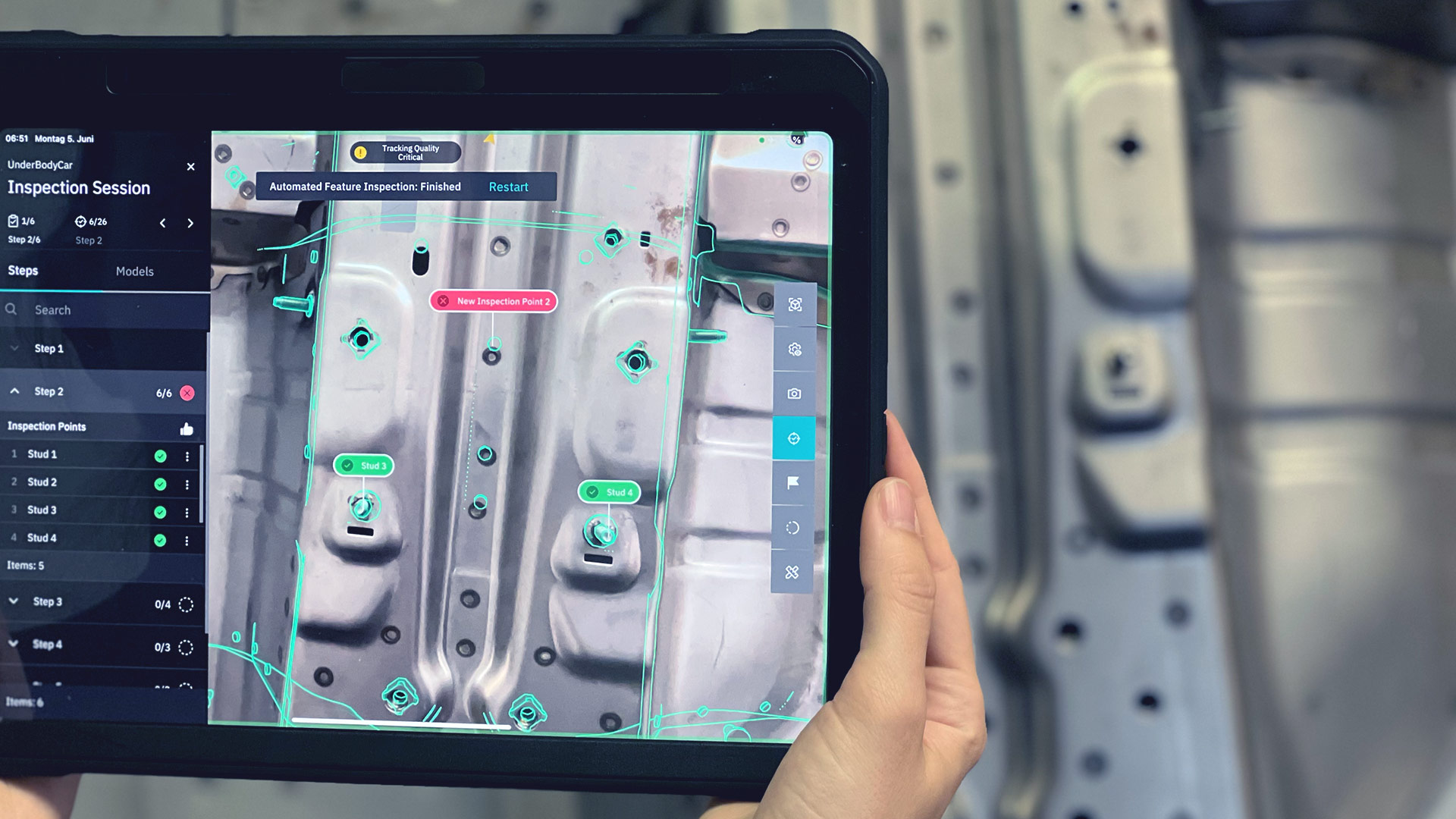
Twyn is Visometry’s mobile AR platform designed for visual quality inspections in manufacturing. It consists of two main components: Twyn Studio (a desktop tool for engineers to import and optimize 3D CAD data, define inspection routines, and deploy projects) and Twyn View (an iOS tablet app that transforms devices into mobile inspection tools). Using computer vision and AR, Twyn automatically registers physical objects via camera capture, overlays digital twins for target/actual comparisons, and detects deviations in geometry, assembly completeness, and component positioning. Key features include codeless workflows, real-time documentation (with annotations and reports in PDF/CSV formats), and integration with enterprise systems for data-driven insights.
Applications are particularly suited to industries like automotive, railway, agricultural machinery, and small-series production, where it supports incoming/outgoing goods inspections, assembly checks, and on-site variance analyses. Testimonials highlight its impact: For instance, at Maschinenfabrik Bernard KRONE GmbH & Co. KG, Quality Engineer A. Audick notes that Twyn enables checks that were previously impossible due to its mobility, allowing inspections directly at large assemblies. Similarly, Chropynska Slovakia’s Quality Manager Kristína Uhrínová praises its role in enhancing production while maintaining high quality.
Overview of Traditional CMMs
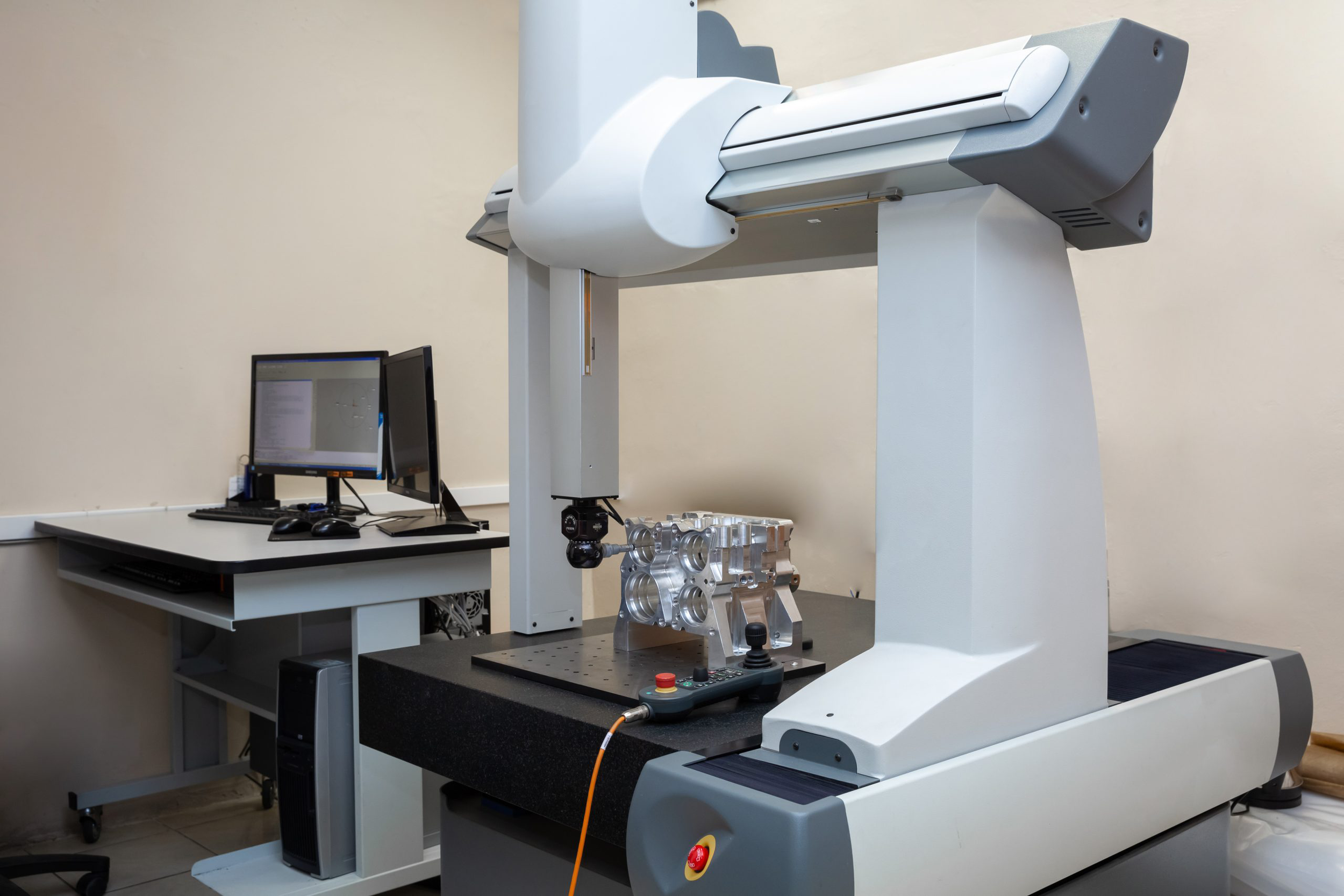
Coordinate Measuring Machines (CMMs) are precision instruments that use a probe (contact or non-contact) to capture data points on a part’s surface, calculating dimensions, forms, and relationships between features in 3D space. They come in designs like bridge, gantry, or portable arm types, often integrated with software for automated programming and reporting. CMMs excel in verifying complex geometries, tolerances, and GD&T (Geometric Dimensioning and Tolerancing) in controlled environments.
Key Comparison Areas
Mobility and Setup
Twyn: Highly mobile, running on standard iOS tablets or AR glasses, enabling inspections anywhere on the production floor without moving parts to a dedicated lab. Setup is quick with drag-and-drop workflows and automatic object registration—no fixed hardware required.
CMMs: Typically stationary (e.g., bridge-type models), requiring parts to be transported to the machine. Portable arm CMMs offer some mobility but are less convenient for large assemblies. Setup involves fixturing, programming, and environmental controls (e.g., temperature stability).
Verdict: Twyn wins for flexibility in dynamic, on-site environments, while CMMs are better for lab-based, high-volume precision work.
Speed and Efficiency
Twyn: Performs real-time inspections with instant deviation detection, reducing setup times and enabling faster checks (e.g., for small-series or variant-rich production). It prevents downtime by embedding inspections into workflows, often faster than traditional scanning methods.
CMMs: Faster than manual measurements (up to 10x), with automated routines for repeatable results, but programming and part loading can add time. Ideal for batch inspections where precision trumps immediacy.
Verdict: Twyn is superior for quick, ad-hoc checks; CMMs excel in streamlined, high-throughput scenarios.
Ease of Use and Expertise Required
Twyn: Intuitive interface with no coding needed; operators without specialized training can perform inspections using guided AR overlays. This democratizes quality control across teams.
CMMs: Require skilled programmers and operators for setup, calibration, and interpretation. While automation reduces errors, initial training is essential.
Verdict: Twyn is more accessible, lowering the barrier for widespread adoption.
Precision and Accuracy
Twyn: Offers precise AR-based alignments and deviation detection, suitable for visual and geometric checks, but may not achieve sub-micron levels for ultra-tight tolerances.
CMMs: Provide unparalleled sub-micron accuracy and repeatability for complex 3D measurements, making them ideal for GD&T verification and high-precision industries like aerospace.
Verdict: CMMs dominate in raw precision; Twyn suffices for many production-floor applications where visual confirmation is key.
Cost and Integration
Twyn: Lower initial costs (software licensing, compatible with existing tablets), with savings from reduced rework, transport, and defects. Integrates easily with CAD systems and enterprise software for real-time data sharing.
CMMs: High upfront investment (machine, probes, software) plus ongoing maintenance and calibration costs. Integration with CAD/CAM systems is strong but can be complex.
Verdict: Twyn is more cost-effective for scalable, mobile needs; CMMs justify costs in precision-critical, high-volume settings.
Limitations and Ideal Scenarios
Twyn Limitations: May lack the absolute precision for sub-micron tolerances or inaccessible features; best as a complement rather than a replacement for CMMs in ultra-precise tasks. (Inferred from focus on visual/AR inspections.)
CMM Limitations: Less adaptable to on-floor variability (e.g., vibrations, temperature fluctuations); not ideal for very large or immovable parts without portable variants.
When to Choose Twyn: For mobile, real-time inspections in automotive assembly, railway maintenance, or low-volume production to catch defects early and reduce logistics.
When to Choose CMMs: For lab-verified, high-precision measurements of complex parts, ensuring compliance in regulated industries.
Hybrid Approach: Many manufacturers use Twyn for preliminary on-site checks and CMMs for final validation, optimizing both speed and accuracy.
In summary, Twyn revolutionizes quality control by bringing AR-driven mobility and simplicity to the shop floor, addressing gaps in traditional CMMs’ stationary nature. However, CMMs remain the gold standard for ultimate precision. For CMM Quarterly readers, integrating Twyn could enhance workflows, especially amid industry pushes for Industry 4.0 and digital twins.

