By Mark Boucher - CMM Quarterly
In the modern industrial landscape, stagnation is a precursor to obsolescence. The manufacturing sector does not reward the companies that reach a peak and rest; it rewards those that view the peak as a mere waypoint to higher ground. This philosophy is the essence of Continual Improvement (CI).
Effective CI is not about a single "eureka" moment; it is the compound interest of operational excellence—small, consistent gains that accumulate into a dominant competitive advantage. This article explores the mechanics of CI, the ISO standards that mandate it, the critical necessity of auditing, and what a robust CI culture means for the health of the manufacturing industry.
1. Defining the Continual Improvement Process
A Continual Improvement Process (CIP) is an ongoing effort to improve products, services, or processes. These efforts can seek "incremental" improvement over time or "breakthrough" improvement all at once.
In manufacturing, CI is often synonymous with methodologies like Lean, Six Sigma, and Kaizen. However, the universal framework that powers almost all these methodologies is the PDCA Cycle (Plan-Do-Check-Act), popularized by Dr. W. Edwards Deming.
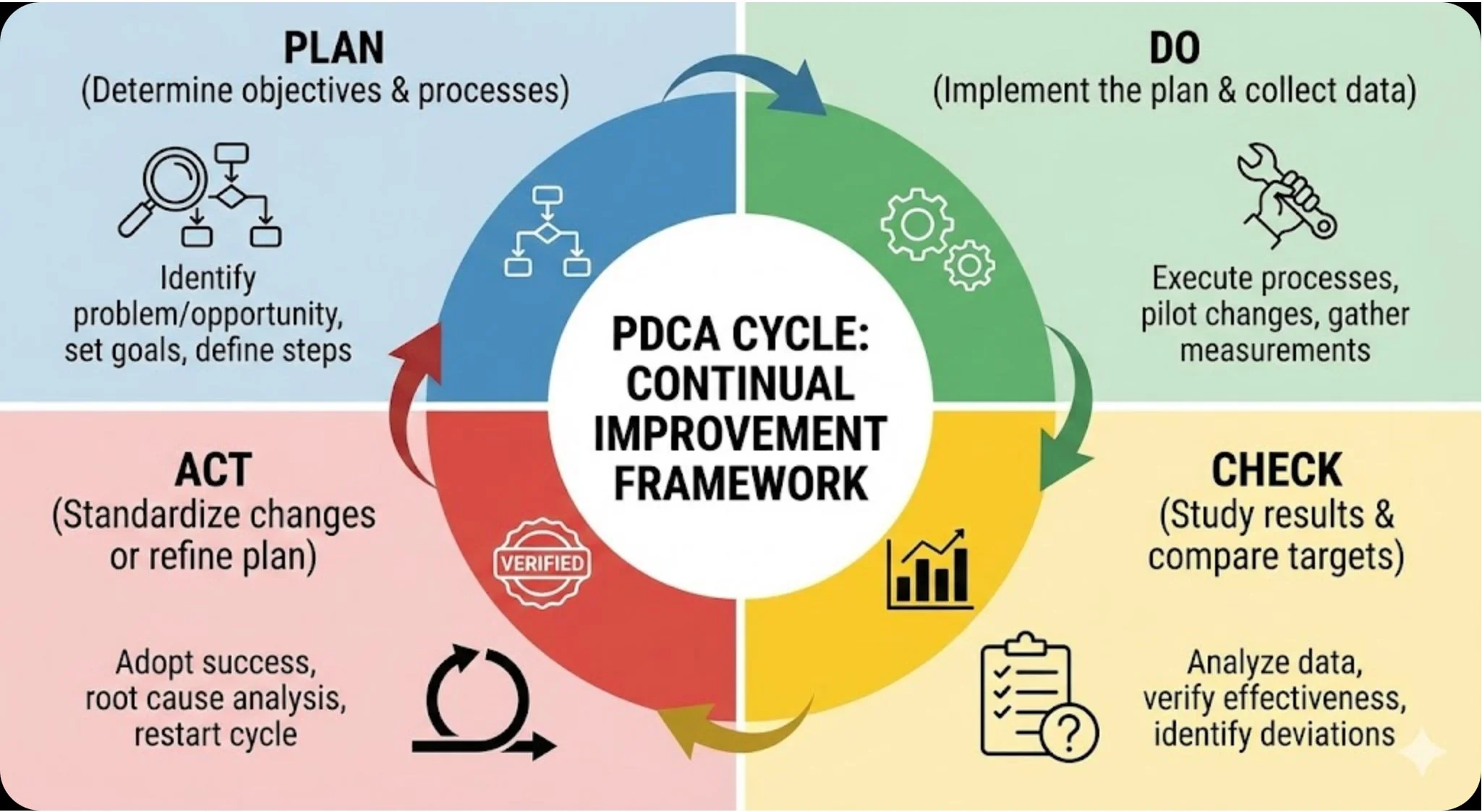
The Phases of PDCA
Plan: Identify the problem or opportunity. specific objectives and processes necessary to deliver results in accordance with the expected output (the target or goal).
Do: Implement the plan, execute the process, and make the product. Collect data for charting and analysis in the following "CHECK" and "ACT" steps.
Check: Study the actual results (measured and collected in "DO") and compare them against the expected results (targets or goals from the "PLAN").
Act: If the "CHECK" shows that the plan was successful, standardize the change. If not, analyze the deviation and begin the cycle again.
2. The ISO Framework: The "spine" of Improvement
While CI can be a cultural mindset, it is also a rigorous requirement of international standards. The ISO (International Organization for Standardization) provides the structural "spine" that ensures CI is not just a slogan, but a documented, auditable reality.
ISO 9001:2015 – The Gold Standard
ISO 9001 is the world's leading Quality Management System (QMS) standard. It does not just suggest improvement; it mandates it.
Clause 10 (Improvement): This specific clause requires organizations to determine and select opportunities for improvement and implement any necessary actions to meet customer requirements and enhance customer satisfaction.
The Process Approach: ISO 9001 shifts focus from inspecting the final product to improving the process that creates the product.
Beyond Quality: A Holistic Approach
For a truly "healthy" manufacturing industry, CI must extend beyond quality into safety and environment:
ISO 14001 (Environmental Management): Continual improvement in reducing waste and carbon footprint.
ISO 45001 (Occupational Health and Safety): Continual improvement in reducing hazards and improving worker safety.
3. The Effectiveness of CI: Why It Works
Why is CI so effective in manufacturing? It leverages the power of marginal gains.
Cost Reduction: By continuously identifying "Muda" (Waste)—such as overproduction, waiting time, or defects—manufacturers lower the cost of goods sold (COGS) without sacrificing quality.
Agility: A company accustomed to constant change (CI) is far better equipped to pivot when market conditions shift than a rigid, static organization.
Employee Engagement: CI empowers the shop floor workers—the experts who actually run the machines—to suggest changes. This ownership boosts morale and retention.
Note: The effectiveness of CI is best tracked using metrics like OEE (Overall Equipment Effectiveness).
OEE=Availability×Performance×Quality
A functioning CI process will see this percentage creep upward consistently over time.
4. Maintaining the Process: Preventing Entropy
The Second Law of Thermodynamics states that closed systems tend toward entropy (disorder). A manufacturing process, left alone, will degrade. Maintaining a CI process requires energy and structure.
Strategies for Maintenance
Standardization (The SDCA Cycle): Before you can improve (PDCA), you must stabilize. Standardize-Do-Check-Act ensures that once an improvement is made, it becomes the new "Standard Operating Procedure" (SOP). Without this, processes slide back to old habits.
Visual Management: Use "Andon" boards and performance dashboards. If a problem is hidden, it cannot be improved.
Gemba Walks: Leaders must go to the "Gemba" (the actual place where value is created). You cannot improve a factory floor from a conference room.
5. The Value of Auditing: The Health Check
If CI is the engine, auditing is the diagnostic tool. Many view audits as "police actions," but in a healthy CI culture, auditing is a value-added activity.
Internal Audits vs. External Audits
Internal Audits (First Party): These are self-assessments. They are crucial for catching drift in processes before they become defects. They ask: Are we doing what we said we would do? Is it effective?
External Audits (Third Party): Conducted by registrars for ISO certification. They provide validation and customer confidence.
The Audit Feedback Loop
An audit identifies a "Non-Conformance." The CI process then kicks in to perform a Root Cause Analysis (often using the "5 Whys" technique) to ensure the issue is resolved permanently, not just patched.
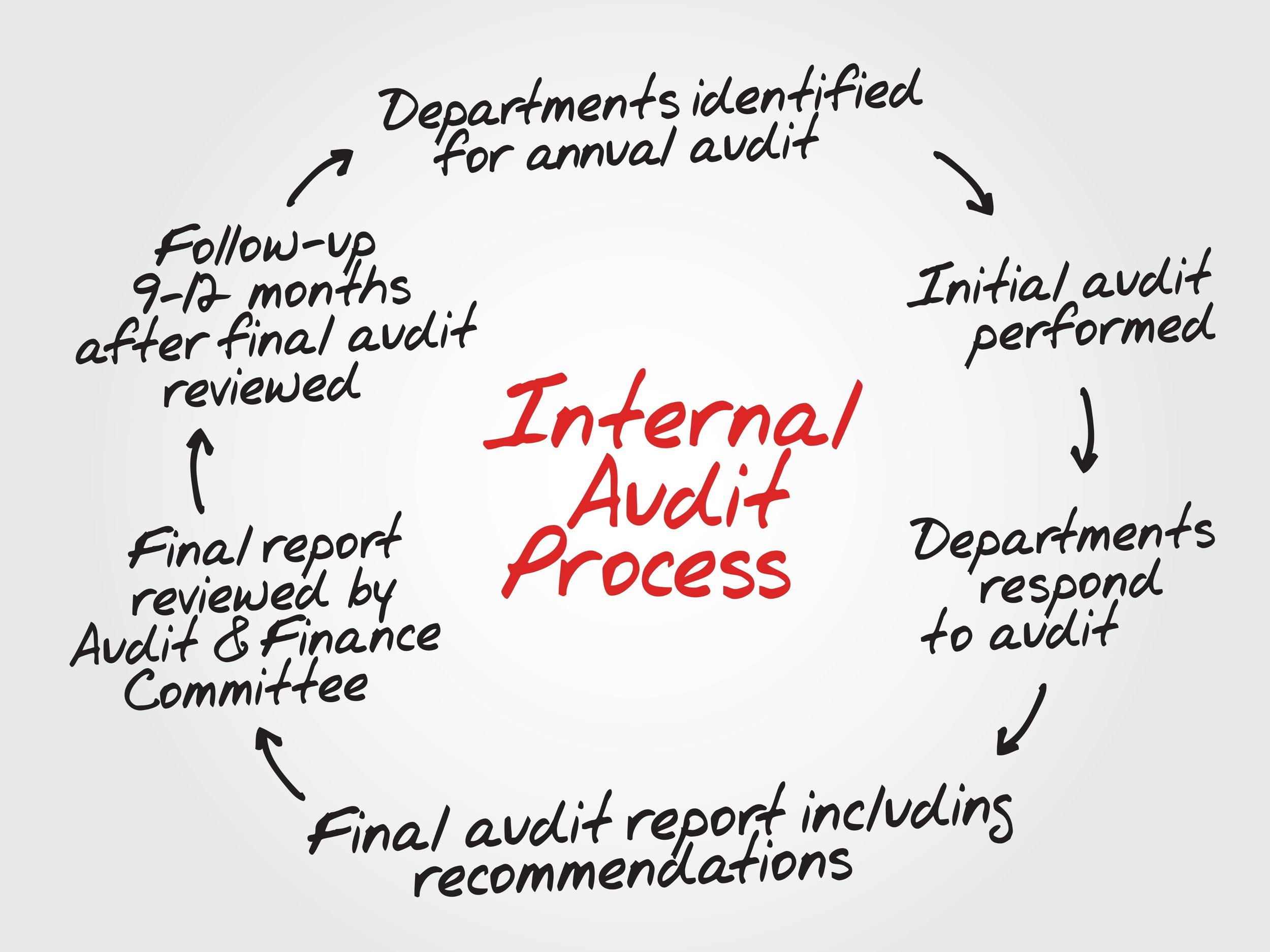
Why Auditing is Vital for CI:
Verification: It validates that the improvements implemented in the "Act" phase of PDCA are actually being followed.
Discovery: Fresh eyes (auditors) often spot inefficiencies that daily staff have become "blind" to.
Risk Mitigation: Audits identify weak points in the supply chain or production line before they result in catastrophic failure.
6. Conclusion: What it Means to a Healthy Manufacturing Industry
A healthy manufacturing industry is not defined by the volume of its output, but by the resilience of its processes.
For the industry, Continual Improvement means:
Sustainability: Reducing energy and material usage per unit.
Competitiveness: Staying ahead of global markets by maximizing efficiency.
Safety: A culture that continuously looks for hazards is a culture that saves lives.
As we move toward Industry 4.0, CI is evolving from manual charts to real-time data analytics. However, the principle remains the same.
Since the article I drafted for you synthesizes established industrial management principles and international standards, here are the core references and authoritative sources that support the content.
These references provide the technical backing for the claims made regarding ISO standards, the PDCA cycle, and manufacturing best practices.
References & Further Reading
1. International Standards (The "Spine" of Improvement)
ISO 9001:2015 Quality Management Systems – Requirements.
Reference for: Clause 10 (Improvement), the Process Approach, and the mandatory nature of CI in quality management.
Source: International Organization for Standardization (ISO)
ISO 14001:2015 Environmental Management Systems.
Reference for: The application of CI to environmental performance and waste reduction.
Source: ISO 14001 Family
ISO 45001:2018 Occupational Health and Safety Management Systems.
Reference for: The integration of CI into worker safety and hazard reduction.
Source: ISO 45001 Information
2. Foundational Methodologies
Deming, W. Edwards (1986). Out of the Crisis.
Reference for: The PDCA (Plan-Do-Check-Act) Cycle and the 14 Points for Management. Dr. Deming is the primary architect of the modern quality movement.
Imai, Masaaki (1986). Kaizen: The Key to Japan's Competitive Success.
Reference for: The philosophy of Kaizen (continuous incremental improvement), Gemba walks, and bottom-up employee engagement.
Liker, Jeffrey K. (2004). The Toyota Way: 14 Management Principles from the World's Greatest Manufacturer.
Reference for: "Muda" (waste) elimination, the importance of long-term philosophy over short-term goals, and standardization as a baseline for improvement.
3. Operational Metrics & Maintenance
Hansen, Robert C. (2001). Overall Equipment Effectiveness: A Powerful Production / Maintenance Tool for Increased Profits.
Reference for: The calculation and application of OEE (Availability × Performance × Quality) as a primary metric for manufacturing effectiveness.
Juran, J.M. & Godfrey, A.B. (1998). Juran’s Quality Handbook.
Reference for: The concept of "breakthrough" vs. "incremental" improvement and the cost of poor quality.
4. Auditing & Process Control
ISO 19011:2018 Guidelines for Auditing Management Systems.
Reference for: The principles of auditing, managing an audit program, and conducting management system audits.
Arter, Dennis R. (2003). Quality Audits for Improved Performance.
Reference for: Moving auditing from a "policing" activity to a value-added diagnostic tool.

