By Mark Boucher

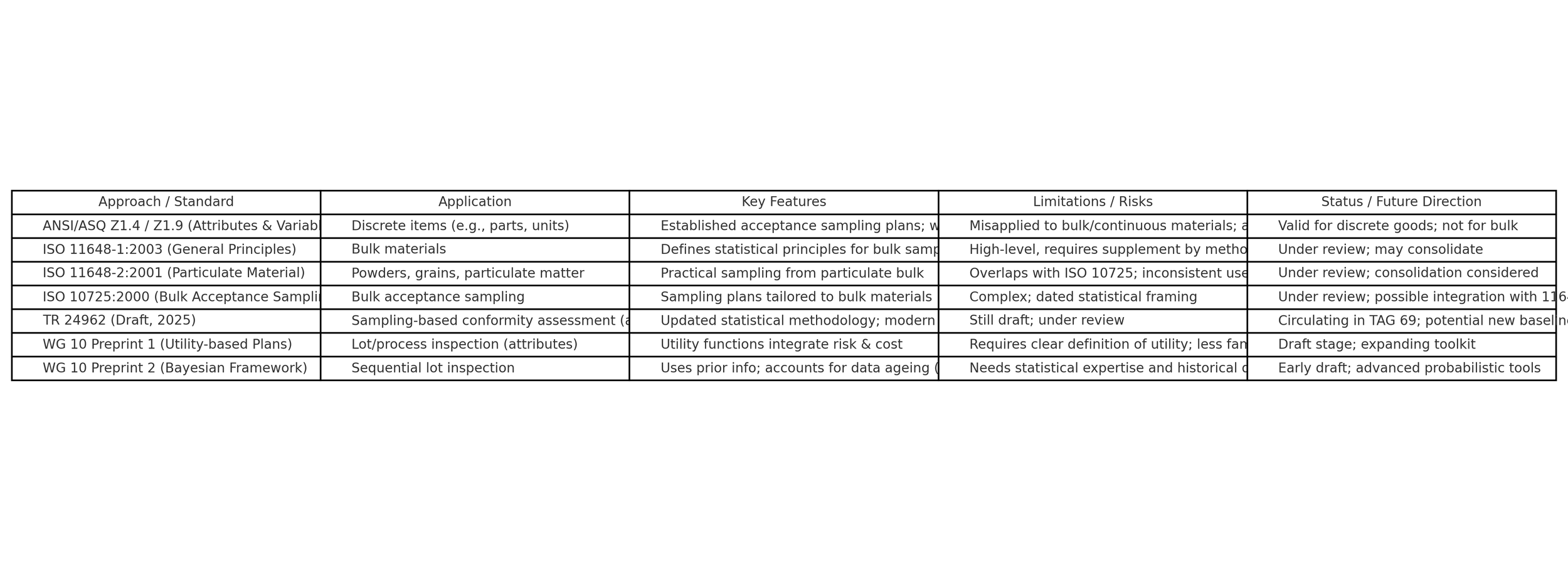
A new draft Technical Report, ISO TR 24962 (“Sampling-based conformity assessment”), is now being circulated among U.S. members of TAG 69 (Technical Advisory Group to ISO/TC 69) for comment. This is part of ongoing work under Subcommittee 5 (SC 5), which handles issues related to acceptance sampling.
Key Components of the Draft and Related Work
• TR 24962, the draft in circulation, focuses on sampling-based conformity assessment. It reflects recent advances in methodology intended to align conformity assessment more closely with modern statistical thinking and industrial practice.
• In addition to TR 24962, TAG 69 SC 5 WG 10 has released two preprints:
1. “Acceptance sampling plans based on utility functions – Inspection of lots and processes by attributes”
2. “Bayesian framework for acceptance sampling—inspection of a series of lots—data ageing and the information half-life approach”
• Also under review are several bulk material sampling standards:
• ISO 11648-1:2003, Statistical aspects of sampling from bulk materials – Part 1: General principles
• ISO 11648-2:2001, Part 2: Sampling of particulate material
• ISO 10725:2000, Acceptance sampling plans and procedures for inspection of bulk materials
SC 5 is assessing whether these three older standards remain adequate given current needs and whether there is an opportunity to consolidate them for simplicity and clarity.
Why This Matters
• Many practitioners mistakenly apply acceptance sampling standards designed for discrete items (e.g. ANSI/ASQ Z1.4, Z1.9) to bulk materials—i.e. materials where constituents are particulate, graded, or continuous. This mismatch leads to poor results or misinterpretations in inspection and sampling. The bulk sampling standards address particular statistical issues not covered well by the standard attribute/variable acceptance plans.
• The new and revised documents are intended to offer guidance better tailored to current industrial practices, including updates for evolving statistical tools (e.g. Bayesian methods, utility-based decision criteria) and data longevity concerns.
Next Steps & Action Items for Stakeholders
• TAG 69 members must review TR 24962 and related drafts and submit comments within the designated feedback period. This is a critical opportunity to shape the technical content, especially around clarity, applicability, and consistency with existing standards.
• After submission and resolution of comments, TR 24962 will proceed toward formal publication. Once published it will influence both national and international conformity assessments and may lead to revisions of older standards.
• Users of bulk sampling standards should monitor the outcome of the consolidation review. Consolidation may reduce duplication and conflicting guidance but may also necessitate changes in sampling and analysis procedures currently in place.
Implications for Practice
• Laboratories, inspection bodies, manufacturers, and quality engineers should begin auditing their current sampling and conformity assessment procedures to identify dependencies on older bulk material standards or attribute sampling methods that may be out of alignment.
• Training programs and quality systems will need to adapt: new methods (e.g. Bayesian acceptance sampling, utility-based decision thresholds) have different assumptions and data requirements.
• Where standards are consolidated, documentation, quality plans, and regulatory compliance may need review to ensure that references, sampling plans, and procedures are updated.