Where efficiency meets human well-being, simulation technologies are paving the way for safer and more productive environments. Visual Components, a leader in 3D manufacturing simulation software, has recently expanded its capabilities through the VC Ecosystem, introducing advanced tools for ergonomics assessment. This article explores how the integration of Work(s) Ergo into the Visual Components platform is transforming the design of manufacturing workflows, drawing from insights available on visualcomponents.com.
Introducing the VC Ecosystem
The VC Ecosystem represents a strategic expansion for Visual Components, launched in January 2026 as a dedicated platform section to highlight partner-developed add-ons, plugins, and integrations. This open ecosystem fosters interoperability, allowing users to enhance their simulations with specialized tools. At its core, it emphasizes incorporating the human element into digital manufacturing models, ensuring that designs prioritize worker safety alongside operational efficiency.
One of the standout features of the VC Ecosystem is its focus on ergonomics, addressing a critical need in industries where manual tasks can lead to musculoskeletal disorders. By integrating third-party solutions, Visual Components enables engineers to simulate and analyze human interactions within factory layouts, identifying potential risks before physical implementation.
The Partnership with Work(s) Ergo
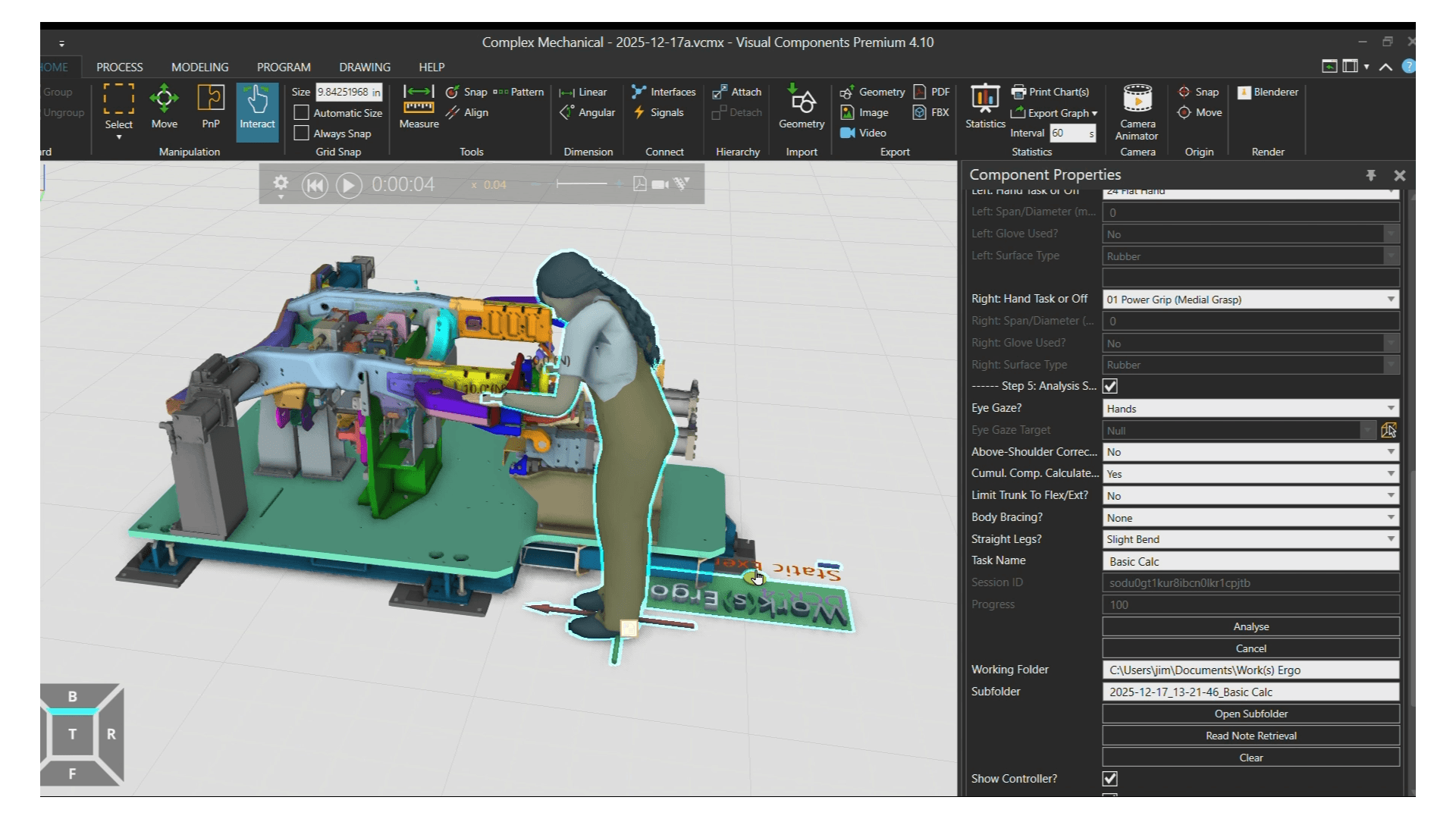
Central to this ergonomics push is the partnership with Work(s) Ergo Inc., announced on January 21, 2026. Work(s) Ergo brings a cloud-based ergonomics analysis tool that seamlessly integrates with Visual Components’ simulation software. This collaboration allows users to perform sophisticated human-factors analyses directly within their 3D models, evaluating musculoskeletal risks and fatigue in real-time scenarios.
As Mikko Urho, CEO of Visual Components, stated, “By collaborating with innovative partners like Work(s) Ergo, we’re expanding the scope of our simulation platform to include the critical human element of manufacturing design.” Dr. Jim Potvin, President of Work(s) Ergo, echoed this sentiment, noting that the integration enhances usability with realistic graphics, enabling quick and reliable optimization of tasks.
The Work(s)™ platform is grounded in validated scientific methods, including HandPak™, the Arm Force Field (AFF), and the Liberty Mutual Manual Materials Handling (LM-MMH) equations. It supports assessments for manual material handling tasks such as lifting, lowering, pushing, pulling, carrying, and maintaining static postures.

Features and Functionality of Work(s) Ergo in Visual Components
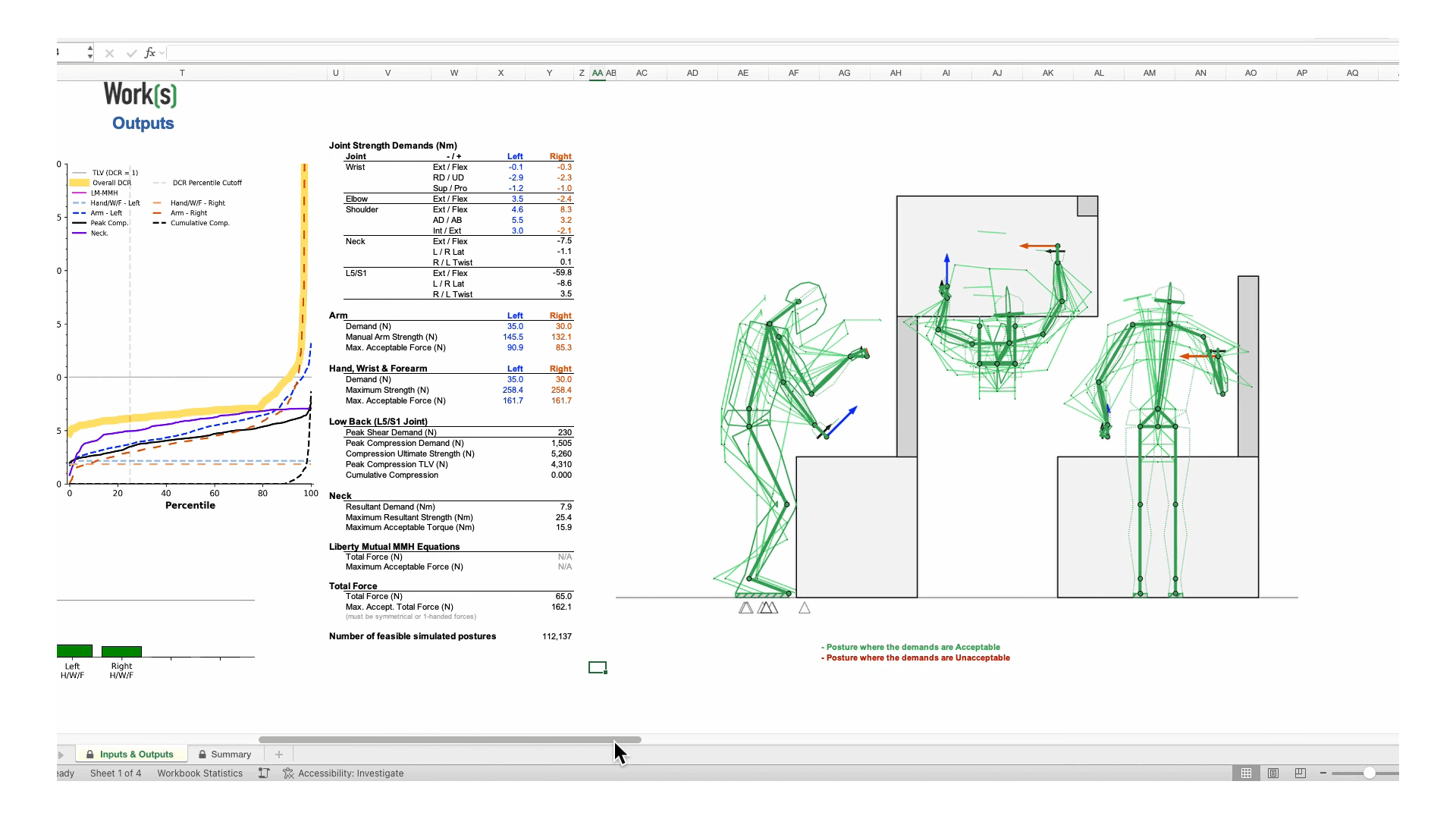
Work(s) Ergo stands out by evaluating thousands of feasible worker postures to account for real human variability, rather than relying on simplistic models. Users can export posture and task data from their Visual Components simulations to the Work(s) cloud service for comprehensive evaluation. The results— including detailed posture analysis, joint load demands, and overall risk scores—are then visualized directly alongside the 3D model.
Key features include:
Integrated Risk Scoring: Combines multiple ergonomics tools into a single, easy-to-interpret risk metric.
Visual Reports: Generates clear numerical and graphical outputs for decision-making.
Scientific Backing: Maintained by ergonomics experts to ensure accuracy and relevance.
Subscription Model: Available as a web-based SaaS tool, requiring Visual Components 4.10 or newer and an internet connection.
This integration turns ergonomic insights into actionable design decisions, helping manufacturers create workflows that minimize injury risks while boosting productivity.
Complementary Ergonomics Tools in Visual Components
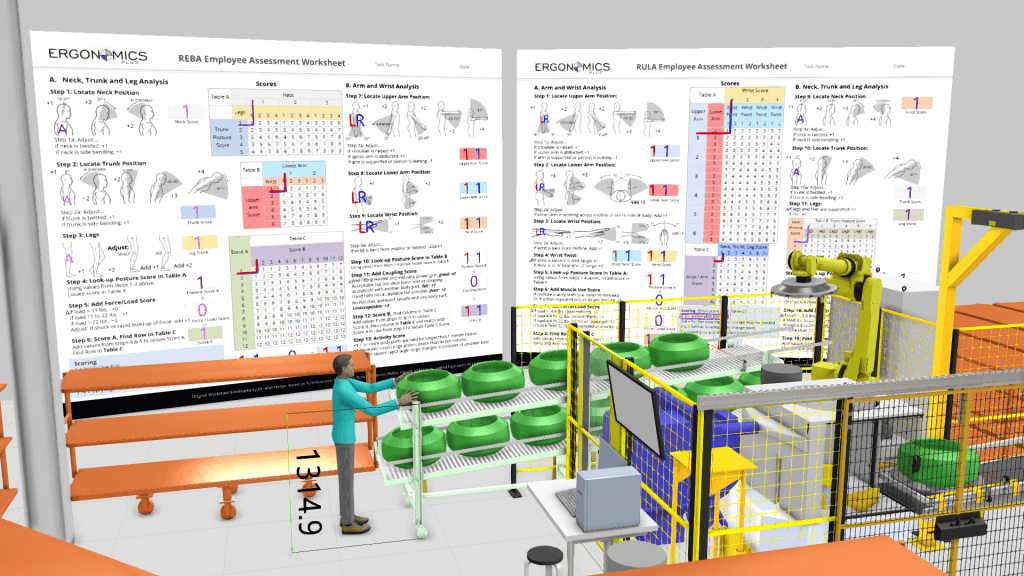
Beyond the Work(s) Ergo add-on, Visual Components offers built-in ergonomics tools through its eCatalog (eCat) updates. For instance, the Rapid Upper Limb Assessment (RULA) tool, introduced in eCat 4.9, assesses risks of upper limb disorders by evaluating posture, force, and movement. It’s currently optimized for the “Adam” human model in simulations, allowing users to set RULA properties and visualize assessments.
Similarly, the REBA (Rapid Entire Body Assessment) tool, added in later updates, provides broader evaluations of whole-body postures. These tools are found under the “Resources” category in the software, enabling quick checks for human ergonomics in layouts.
Real-World Application: Michelin’s Use Case
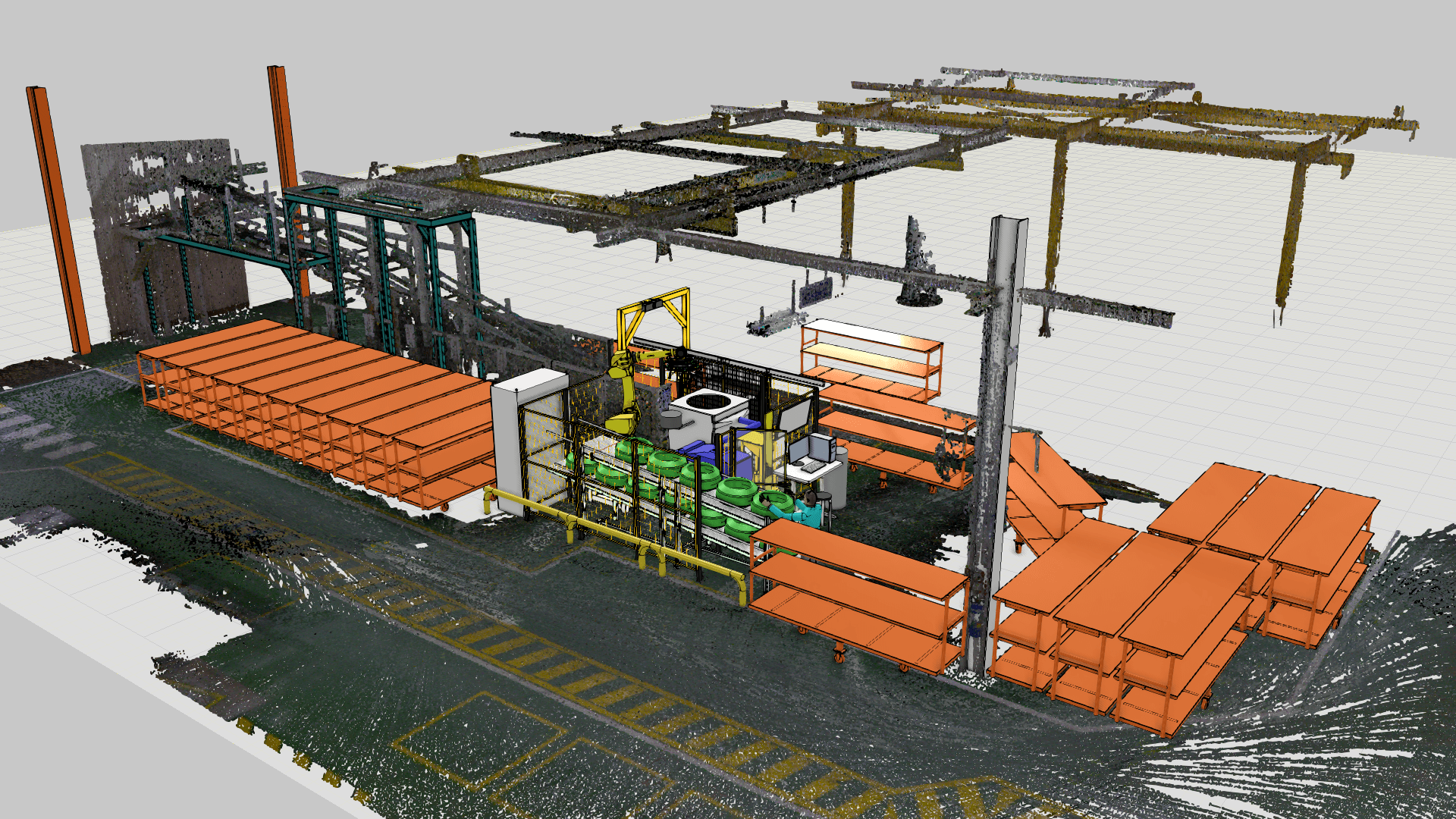
A prime example of these tools in action comes from Michelin, which leverages Visual Components to streamline manufacturing planning with a strong emphasis on ergonomics. In their simulations, human figures and reference measurements are incorporated to verify operator comfort. For instance, using the REBA Employee Assessment Worksheet, teams ensure that conveyor heights allow average-height operators to reach controls without strain.
Michelin also analyzes workflows to minimize walking distances and twisting motions, reducing fatigue and enhancing efficiency. Simulations validate maintenance access, such as forklift removal of robots, while accounting for safety fencing. This approach fosters collaboration among production, maintenance, safety, and ergonomics teams, resolving issues virtually before real-world deployment.
Conclusion
The VC Ecosystem, bolstered by the Work(s) Ergo integration, marks a significant advancement in manufacturing simulation. By embedding advanced ergonomics analysis into digital twins, Visual Components empowers designers to prioritize human health without compromising on performance. As industries continue to automate, tools like these ensure that the factory floor remains a safe and efficient space for workers. For more details, visit visualcomponents.com to explore the ecosystem and its growing array of solutions.

