Image: Verisurf
Reverse engineering has evolved far beyond its early role of simply duplicating parts when original designs were unavailable. Today, it has become a strategic capability in manufacturing, enabling rapid prototyping, extending product life cycles, enhancing production workflows, and even driving new design innovation. Advances in metrology, 3D scanning, and AI-powered software have transformed reverse engineering from a reactive problem-solving tool into a proactive source of competitive advantage.
In industries ranging from aerospace to automotive and healthcare, reverse engineering is reshaping how engineers approach design and production. Complex prototypes can now be digitized into CAD models quickly, allowing for rapid iterations without starting from scratch. Parts can also be adapted for different manufacturing processes—such as shifting a component originally made for casting into one optimized for CNC machining or additive manufacturing. For companies tasked with maintaining or restoring aging systems, digital twins of worn or damaged parts provide precise data to reproduce components when OEM documentation is missing.
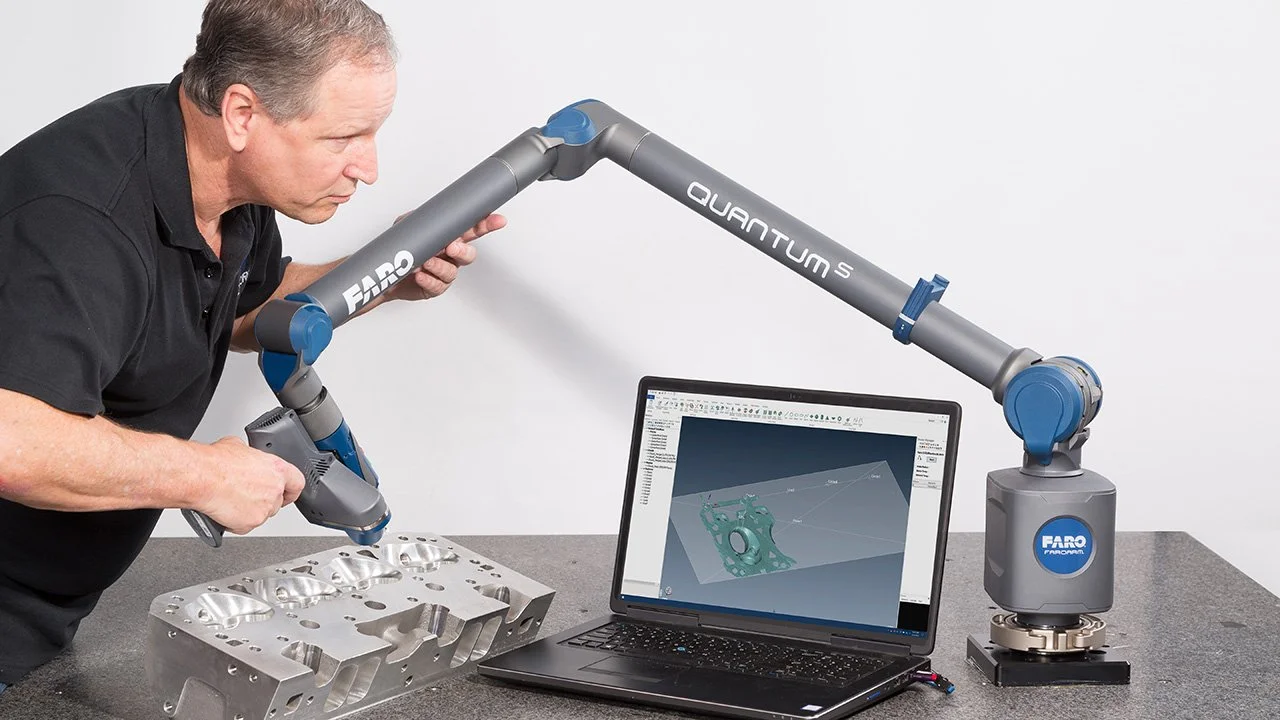
The real catalyst for this transformation has been high-resolution 3D scanning technology. Modern laser, structured light, and CT-based scanners capture millions of points per second with sub-millimeter precision, enabling accurate digitization of complex geometries. Whether scanning delicate surfaces, large assemblies, or challenging materials, these systems make it possible to bring physical parts into the digital workflow with remarkable speed. By embedding scanning directly into production environments, manufacturers can compare prototypes in real time, catch dimensional errors early, and avoid costly redesigns downstream.
Equally important are the software platforms that process and interpret scan data. Today’s AI-driven tools automatically detect geometric features, merge freeform surfaces with solid models, and integrate seamlessly into CAD environments for immediate modification. Deviation analyses provide rapid quality checks, while cloud-based collaboration tools allow globally distributed teams to work on the same scan data simultaneously. This dramatically accelerates development cycles and improves communication across engineering, quality, and production groups.
Reverse engineering is no longer limited to R&D; it is now firmly embedded in production. Manufacturers use it to monitor tooling wear, verify first-article inspections, and feed actual part geometry into digital thread and PLM systems for better traceability and compliance. In industries where supply chain disruptions or obsolete parts threaten operations, reverse engineering ensures continuity by enabling manufacturers to reproduce or adapt parts without depending on OEM availability.
Perhaps the strongest synergy lies between reverse engineering and additive manufacturing. By capturing complex shapes and optimizing them for weight reduction, strength, or new functionality, engineers can create production-ready components that were once impossible to design conventionally. This integration is transforming industries such as aerospace, where lightweight brackets are in constant demand, and healthcare, where custom implants and prosthetics can be produced with unprecedented precision and speed.
Looking ahead, reverse engineering is moving toward a closed-loop, data-driven ecosystem. Imagine scanning a part on the shop floor, allowing AI-driven software to instantly detect deviations, update the CAD model, and feed that information back into production within minutes. This convergence of metrology, predictive analytics, and digital twin systems closes the gap between the physical and digital worlds. Far from being a backward-looking discipline, reverse engineering has become a forward-driving innovation engine—one that shortens time-to-market, revitalizes legacy systems, and makes once unmanufacturable products a reality.

