By Michael Tyrrell
Automating precision: how Mitutoyo Computer Technology Laboratory transformed measurement programming through intelligent software. PES reports.
For more than four decades, Mitutoyo CTL (Computer Technology Laboratory) has been shaping the digital backbone of Mitutoyo’s global measurement systems. Since 1983, CTL Germany has been responsible for developing leading metrology software – but one achievement stands out as a true milestone of innovation: MiCAT Planner.
A turning point for industry: the need for automation
As manufacturing shifted from 2D drawings to fully annotated 3D CAD models with product manufacturing information (PMI), companies faced a dilemma: despite having rich 3D data, measurement programs were still being created manually, slowly, inconsistently, and heavily dependent on experienced metrology specialists.
Petra Brieger, feature owner of MiCAT Planner, long-time CTL expert, and part of the team for 14 years, describes the challenge clearly: “Customers had powerful CAD models, but they lacked a fast and reliable way to convert all this PMI data into a high-quality measurement program. MiCAT Planner was our answer to this industrywide problem.”
The demand was obvious. Customers needed: faster programming; standardised measurement strategies; improved quality and traceability; and fewer dependencies on rare expert profiles – and they needed it across all industries, automotive, aerospace, medical devices, and more. MiCAT Planner was designed to meet exactly these needs.
The vision: from CAD model to measurement program
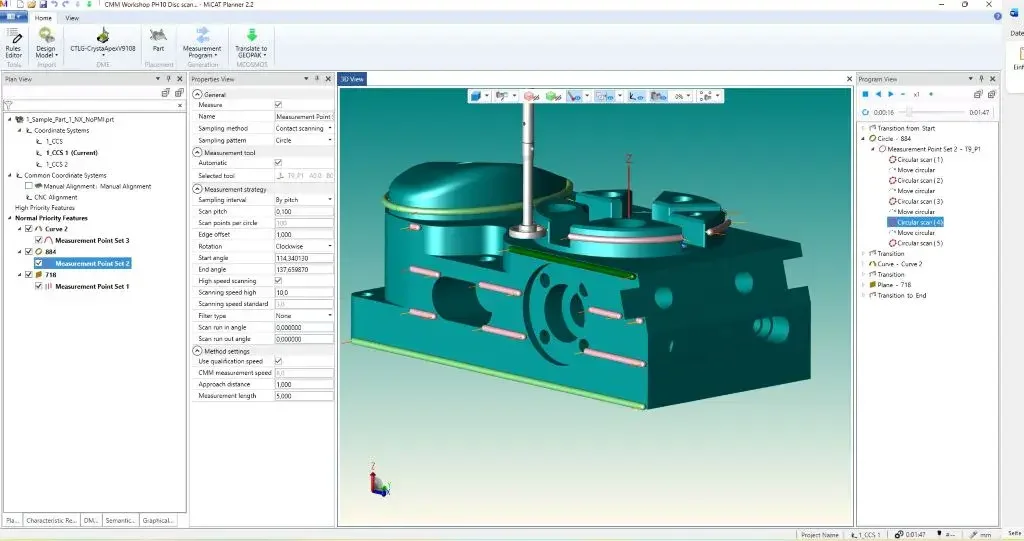
From its earliest concept, MiCAT Planner had one purpose: to transform CAD/PMI information into a complete CNC measurement program, automatically, efficiently, and consistently.
Petra Brieger recalls the ambition behind the project: “We wanted to take a big step into Industry 4.0 and automate what was previously expert work. If we could embed metrology knowledge directly into the software, customers could save significant amounts of time and get consistent results.”
The vision was bold. MiCAT Planner would not only read and interpret PMI; it would apply optimised rules, select appropriate probes and tools, generate collision-free paths, and produce a complete, ready-to-run program, even before the physical part existed.
“It wasn’t meant to be just an assistant; it was meant to be a partner that thinks like an expert,” Ms Brieger confirms.
Engineering excellence: building MiCAT Planner
The development of MiCAT Planner was a coordinated global effort. Mitutoyo CTL led the project, closely supported by Mitutoyo teams in Belgium and the USA, each contributing specialised expertise such as CAD translation, path optimisation, feature recognition, or application workflows.
Petra Brieger emphasises the importance of collaboration: “This was never a one person project,” she affirms. “It succeeded because the team stood together, across countries and time zones. Whenever we faced a challenge, we solved it as one team. Beyond their strong development skills, our software developers bring many years of experience and deep metrology expertise that directly shape the product.”
Working with different CAD formats, external geometry libraries, and highly complex logic was demanding. The team had to constantly balance computing speed with accuracy, powerful features with ease of use, and advanced geometry processing with external limitations. Despite this complexity, MiCAT Planner grew into a robust, reliable, and globally scalable solution.E
Breakthrough moments
Looking back, Ms Brieger highlights three defining milestones:
The first release, MiCAT Planner 1.0: “It proved the concept. We showed that rule-based, CAD-driven programming was possible.”
From version 1.9 onwards: “A big step forward. Now we had a mature, professional product.”
Real customer feedback: “When users and application engineers started telling us how much faster and easier their work had become, that was incredibly rewarding.”
For her, the biggest success was not a version number, but the moment industry specialists themselves recognised MiCAT Planner as a breakthrough.
What makes MiCAT Planner so innovative?
MiCAT Planner stands out because it combines several strengths rarely found together:
Rule-based logic: customers can define their own measurement strategies, ensuring perfectly consistent programs across employees, departments, and global sites. Ms Brieger explains. “No matter who presses the button, the logic behind the program is always the same. That level of standardisation is unique.”
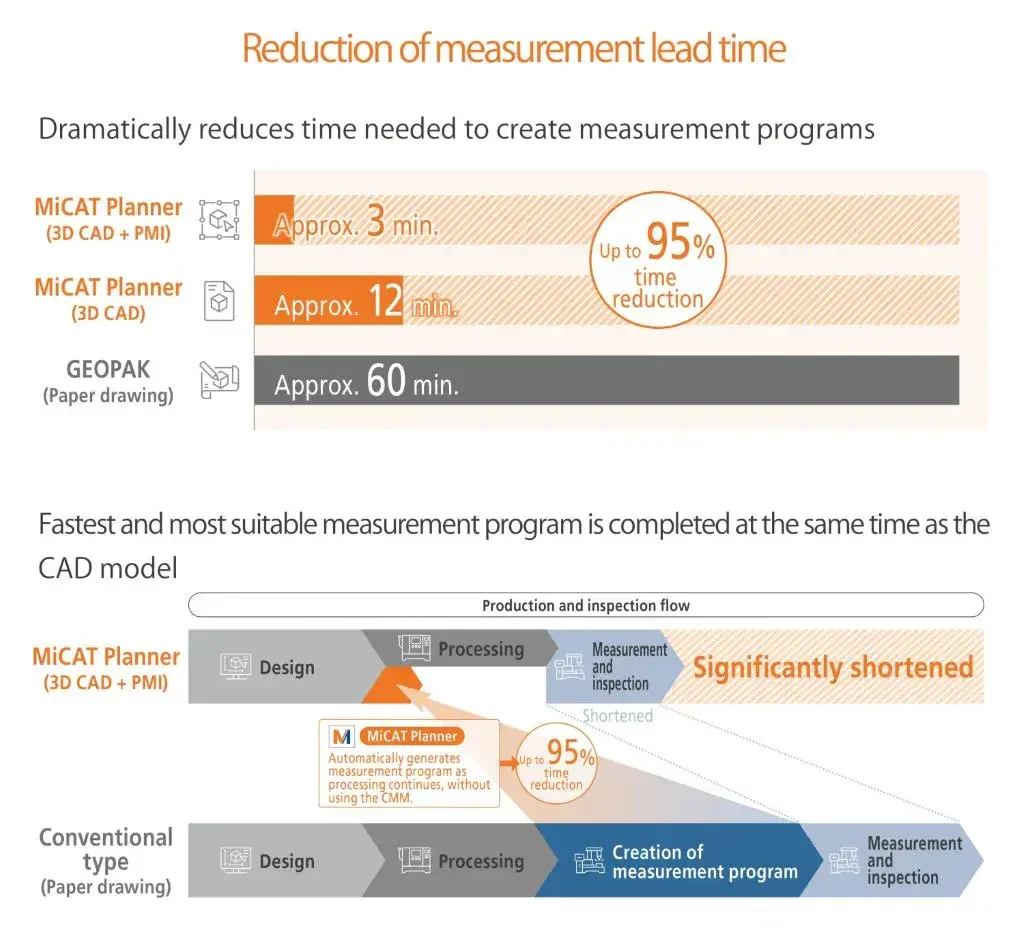
Massive time savings: customers routinely report programming time reductions of 80–95%, especially on PMI-rich models.
Reliability and collision safety: smart path planning and optimised tool changes deliver stable, predictable, and safe programs.
Ease of adaptation: because the logic is CAD-based, programs can easily be tuned to different CMMs or configurations without starting from zero. Also, if a new revision of the CAD model is available, it can be replaced in the existing project and all changes/settings from the project are retained and transferred to the new model.
A Mitutoyo differentiator: Petra Brieger emphasises: “Some customers choose Mitutoyo specifically because MiCAT Planner exists. It gives us a clear competitive advantage.”
Real impact on manufacturing
Mitutoyo says MiCAT Planner has transformed the daily work of metrology teams worldwide. Tasks that once took hours or days can now be completed in minutes. Offline programming frees up machines, accelerates production cycles, and makes metrology scalable, even with fewer expert operators available.
“Application engineers frequently praise the software for its stability and efficiency,” Ms Brieger enthuses. “Hearing from engineers and customers that they wouldn’t go back to manual programming is the best feedback we could get.”
The human side of success
One of the most meaningful aspects of working on MiCAT Planner is the culture at CTL: “The teamwork was exceptional,” Petra Brieger asserts. “Nobody said, ‘that’s not my problem.’ We shared mistakes, we shared successes, and we held the same goal.”
She also highlights the pride that comes from building something truly innovative: “It’s motivating to know you’re working on software that contributes to Mitutoyo’s global reputation. MiCAT Planner is something special; no other company has a solution like this.”
The future of MiCAT Planner
The journey is far from over. Ms Brieger sees enormous potential for the next generation of automated metrology: “We built a strong foundation; now we can move toward even smarter automation. AI-supported interpretation, adaptive rules, integration into digital manufacturing, and even closed-loop processes.”
Future developments may include: AI-enhanced decision-making; increasingly intelligent path optimisation; tighter workflows between CAD, CAM, and CMM; advanced simulation and validation; and deeper integration with MiCAT ecosystem tools. MiCAT Planner is ready for the next wave of Industry 4.0 and CTL will continue shaping its evolution.
Mitutoyo
https://mitutoyo.eu/uk