In the high-stakes world of coordinate metrology, where every micron counts and inspection routines can span hundreds of features across complex geometries, traditional programming has long been a bottleneck. Teach pendants, CAD-based path planning, and custom scripts demand specialized expertise, lengthy setup times, and rigid workflows. But what if a quality engineer could simply say, “Measure all critical dimensions on this component and generate a report,” and a robotic inspection system executed the task flawlessly—adapting on the fly to part variations or environmental changes?
Researchers from Huawei Noah’s Ark Lab, the Technical University of Darmstadt, and ETH Zurich have introduced a groundbreaking open-source framework that makes this vision reality. Dubbed ROS-LLM, the system seamlessly integrates large language models (LLMs) with the Robot Operating System (ROS), the de facto standard for industrial robotics. By bridging high-level human intent with low-level robotic control, it promises to democratize advanced metrology operations and usher in an era of intuitive, cognitive automation for CMMs and automated inspection cells.
From Code to Conversation: How ROS-LLM Works
Traditional robot programming relies on structured code and predefined behaviors. ROS-LLM flips the script. An LLM-powered language understanding layer interprets natural-language commands—handling ambiguity, context, and even incomplete instructions. A task-planning layer then decomposes these into executable sequences, drawing on an extensible library of atomic actions. Finally, the ROS execution layer translates everything into real-world motion, sensor fusion, and actuation.
Crucially, the framework supports dynamic adaptation. If an obstacle appears, a probe tip fouls, or a part shifts slightly on the fixture, the system reassesses, proposes alternatives, and seeks human feedback when needed. It also incorporates imitation learning, allowing non-experts to teach new actions simply by demonstrating them, and uses Bayesian optimization to fine-tune parameters for optimal performance in metrology tasks.

Metrology Applications: Precision Meets Intuition
For CMM users and quality professionals, the implications are transformative. Consider an automated robotic inspection cell equipped with a multi-axis arm and non-contact scanner. Instead of writing or importing a detailed measurement program, an operator could issue voice or text commands such as:
“Perform a full GD&T inspection on the engine bracket, focusing on the mounting holes and datum surfaces.”
“Scan the turbine blade for surface deviations and compare against the nominal CAD model.”
“Measure the bore diameters on this batch of 50 parts and flag any outside tolerance.”
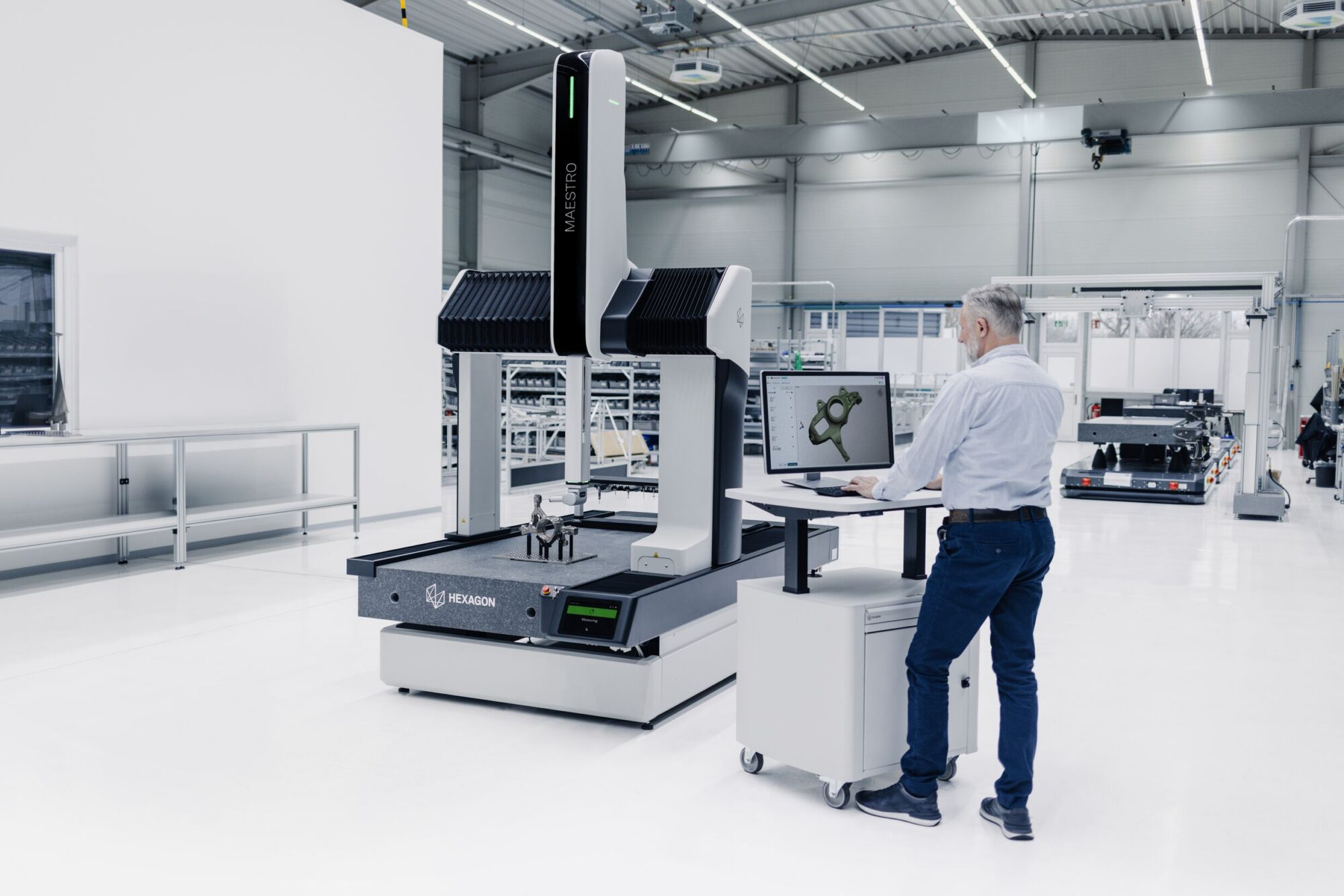
The ROS-LLM framework converts these instructions into precise robot paths, probe or scanner commands, and reporting routines—all while interfacing with existing metrology software. In hybrid CMM-robotic setups, the system could even coordinate between fixed bridge CMMs and mobile manipulators for inline or near-line inspection.
Early validation experiments (including tabletop manipulation and complex multi-step tasks) demonstrate the framework’s robustness across embodiments, from fixed manipulators to legged mobile robots. In metrology environments, this translates to faster changeovers for new part families, reduced training curves for shop-floor staff, and greater flexibility in high-mix, low-volume production.
Key Benefits for Quality and Manufacturing
Accessibility: QC technicians without deep programming backgrounds can now drive sophisticated systems.
Speed: Natural-language setup slashes programming time from hours to minutes.
Adaptivity: Real-time re-planning handles part-to-part variation, tool wear, or environmental shifts—critical in aerospace, automotive, and medical device metrology.
Traceability: The framework logs reasoning steps and actions, supporting ISO and AS9100 compliance requirements.
Integration: Works with open-source and commercial LLMs, and is fully compatible with existing ROS-based CMM and robotic platforms.
Challenges on the Horizon
Reliability remains paramount in metrology, where measurement uncertainty must stay within tight bounds. LLM hallucinations or ambiguous commands could introduce errors, so the framework emphasizes human-in-the-loop oversight, reflection mechanisms, and verifiable atomic actions. Real-time performance is another focus—optimized inference ensures commands execute without latency that could affect high-speed scanning. Finally, full traceability and auditability of AI-driven decisions will require ongoing validation against gold-standard manual or scripted methods.30
The Future of Cognitive Metrology
ROS-LLM is more than a programming aid—it represents a fundamental shift toward cognitive robotics in quality assurance. As LLM capabilities advance and integration with vision systems, digital twins, and closed-loop feedback matures, we can envision fully autonomous inspection cells that not only measure but also diagnose root causes and suggest process improvements.
For CMM Quarterly readers on the front lines of precision manufacturing, this framework signals an exciting opportunity: the end of tedious programming and the beginning of truly conversational metrology. Manufacturers who adopt early will gain a competitive edge in agility, talent utilization, and inspection throughput.
The complete ROS-LLM implementation is open-source and available on GitHub, inviting the metrology community to experiment, customize, and contribute.
References
Mower, C.E., et al. “ROS-LLM: A ROS framework for embodied AI with task feedback and structured reasoning.” Nature Machine Intelligence (2026). arXiv:2406.19741.7
“The End of Programming? Natural Language Interfaces in Industrial Robotics.” Metrology and Quality News (April 14, 2026).30
Additional coverage: TechXplore, Interesting Engineering, and Huawei Noah’s Ark Lab announcements (April 2026).0
Images courtesy of industry sources illustrating CMM technology and robotic metrology applications.