Author: Mark Boucher - CMM Quarterly
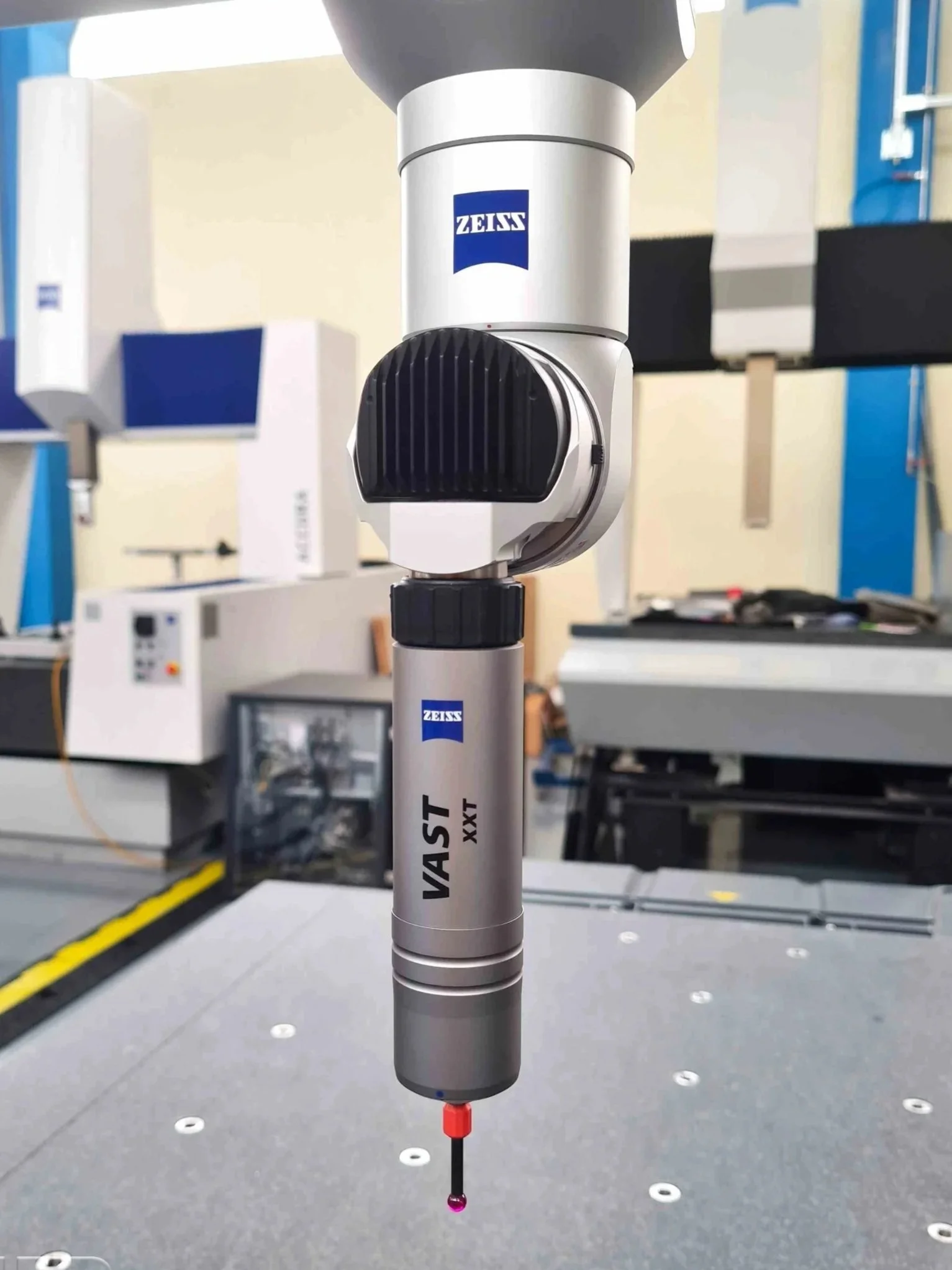
Abstract: This article documents the mechanical design principles, kinematic chain, and practical considerations for the ZEISS articulating probe carrier RDS used with the VAST-XXT tactile scanning probe. It combines manufacturer documentation with engineering inference to explain how the system achieves wide angular reach, repeatable positioning, and compact, high-accuracy scanning. Where a design detail is inferred rather than explicitly stated in public documentation, the text is explicit about that distinction. Key factual points are cited to ZEISS product pages and datasheets. (Zeiss)
1. Introduction
Articulating probe carriers such as the ZEISS RDS are a standard solution for accessing complex workpiece geometry on CMMs. When paired with the VAST-XXT scanning probe they allow tactile scanning into deep bores and tight spaces while maintaining high measuring accuracy. The RDS provides a large number of discrete angular settings (industry literature notes 20,736 positions with 2.5° indexing resolution) while the VAST-XXT supplies the tactile sensing element. (Zeiss)
This paper focuses on the mechanical subsystems that make up the combined RDS/XXT assembly: the three-point mount (ST3 dovetail), the articulating index joints (yaw/pitch), the adapter plate and dovetail interface, stylus mounting and kinematic interfaces, and the passive scanning probe mounting and counterbalancing features. Manufacturer statements are cited; where internal geometry (e.g., detent shapes, bearing types) is not publicly documented, reasonable engineering inferences are annotated as such.
2. Functional decomposition
At a high level the system comprises:
ST3 mounting interface (base) — reproducible 3-point mount to the machine head. Allows secure, repeatable attachment/detachment. (Zeiss)
RDS articulating carrier — a multi-axis mechanical indexing assembly that provides yaw and pitch articulation in small angular increments (2.5° reported step). This carrier accepts an RDS adapter plate.
Adapter plate / dovetail — mechanical adapter that connects the VAST-XXT probe to the RDS carrier, with an electrical/LED status indicator on the adapter in some variants. (ZEISS Qualityforum)
VAST-XXT probe head (sensor body) — passive scanning tactile probe with stylus mounting, stylus quick-change features and small scanning tip geometry for high-precision contact scanning. (Zeiss)
Each of these subsystems contributes to the probe head’s kinematic chain, stiffness, and repeatability. The mechanics must balance accessibility (long, slender styli and deep reach) with rigidity (to maintain scanning accuracy) and reproducibility (index-to-index repeatability and mounting reproducibility).
3. Kinematic and mechanical design principles
3.1 Mounting and repeatability
ZEISS uses a three-point, reproducible mount (ST3) for probe carriers. This mounting scheme constrains six degrees of freedom deterministically when tightened and produces high repeatability when reinstalled. The manufacturer also highlights a dovetail / single-screw replacement convenience for sensors — this eases field replacement while maintaining a defined kinematic interface. (Zeiss)
Engineering note (inference): A three-point indexing mount plus a dovetail suggests that precise locating faces and hard stops are used; preload screws and a single central locking screw provide the clamping force while the three locators set the position.
3.2 Articulation and indexing
The RDS articulating head provides a wide angular workspace with fine indexing: documentation lists 2.5° indexing steps and a total of ~20,736 discrete positions (product literature). Mechanically, this is typically implemented as concentric indexed axes (e.g., nested yaw and pitch rings) with a detent/rachet style indexing wheel or a gear-tooth indexing ring combined with a locking mechanism.
What this implies mechanically:
Nested axes use precision bearings or plain pivot journals sized for low runout.
Indexing is accomplished by a high-precision ring with discrete detent positions (captive ball/dog engaging holes, or a fine gear tooth set) and a clamp/lock to secure the chosen angle.
The resolution (2.5°) and total positions count match an indexing ring with multiple axes/positions.
3.3 Sensor mounting and quick-change adapter
The VAST-XXT attaches to the RDS via an adapter plate (the RDS-XXT adapter). ZEISS docs and third-party parts lists describe an adapter plate and indicate an LED behavior when the adapter is first seated — showing that the adapter integrates the mechanical interface with a minimal electrical/identification feature for the head system. ( ZEISS Qualityforum)
Design benefit: Adapter plate standardizes the probe mounting geometry and styli stack alignment, enabling rapid swaps and maintaining measurement offsets across different probes.
3.4 Stylus system and passive scanning
The VAST-XXT is a passive scanning probe (no active electronics in the moving stylus assembly) designed for high-precision tactile scanning with small diameters and slender stylus lengths. ZEISS literature highlights compact design, high measuring accuracy, and compatibility with the RDS articulator. (Zeiss)
Mechanically this requires:
A stiff, low-mass stylus mounting with fine threads or a kinematic coupling for repeatable assembly.
A counterbalance or passive damping system in the probe (some machine families include passive damping/counterbalance) to avoid unwanted oscillations during scanning. (Zeiss)
4 Assembly / exploded view (RDS + adapter + VAST-XXT)

RDS/ XXT Configuration
A. RDS Head
B. VAST XXT Probe
C. XXT Adapter Plate
5. Materials, bearings, and stiffness considerations (engineering guidance)
Materials: Typical probe carriers use lightweight, stiff aluminum alloys for housings (to reduce mass on the machine head) and stainless or hardened steel for stylus shanks and threaded inserts. Critical bearing surfaces or indexing rings are often steel with hardening or ceramic bearing elements for wear resistance. (This is standard practice; ZEISS does not publicly publish the detailed alloys in the RDS product pages.)
Bearings / pivots: Precision ball bearings or cylindrical journal bearings with preload provide the required low runout for pivot axes. Where indexing and high stiffness are required, tapered roller bearings or angular contact bearings may be used for axial load capacity. (Manufacturer literature emphasizes precision indexing but does not enumerate bearing types.)
Counterbalancing and damping: When long stylus stacks are used, counterbalancing or passive damping reduces dynamic deflection during scanning. ZEISS mentions passive damping/counterbalance in some machine product material. (Zeiss)
6. Accuracy, repeatability, and practical operating notes
Indexing resolution & positions: Product materials indicate 2.5° indexing and up to 20,736 positions across the available axes — this directly affects reachable orientations and planning of scanning sequences.
Mounting repeatability: The ST3 three-point mount and dovetail adapter permit rapid swaps with reproducible offsets when performing probe/sensor changes. ZEISS documentation explicitly highlights simple sensor replacement and a single screw for some adapters. (Zeiss)
Calibration & qualification: ZEISS sensor cookbooks and calibration procedures recommend qualifying sensors and stylus stacks; the VAST-XXT is commonly used as the reference contact probe for optical probe calibrations on some ZEISS systems. Follow official calibration cookbooks and software stylus menus (CALYPSO) for best results. (Zeiss)
7. Maintenance, troubleshooting and safe practices
Always follow ZEISS operator manuals for mounting/unmounting procedures. Forums indicate specific button sequences for manual stylus release or emergency procedures — but follow vendor instructions first. (ZEISS Qualityforum)
Check indexing clamps and detents for wear; periodic inspection of locating pins, dovetail faces, and stylus threads preserves repeatability. Use the manufacturer’s recommended torque values when tightening locking screws — overtightening can distort locating surfaces and reduce repeatability.
8. Summary and engineering recommendations
The ZEISS RDS articulating head combined with the VAST-XXT probe provides a flexible, high-precision solution for tactile scanning in constrained geometries. Manufacturer literature documents fine indexing (2.5°) and many angular positions, a reproducible ST3 mount, and a VAST-XXT passive tactile probe optimized for accurate scanning. (Zeiss)
For engineering teams designing fixtures, plan for the RDS articulation envelope and ensure clearance for stylus paths. Use short, stiff stylus configurations where possible to reduce deflection, and verify probe qualification and calibration per ZEISS cookbooks and procedures prior to high-accuracy scanning. (Zeiss)