By Mark Boucher - CMM Quarterly
Abstract
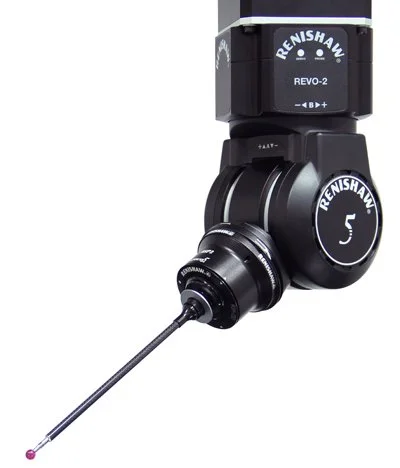
Renishaw’s REVO® is a two-axis, air-bearing probe head that, when paired with a CMM’s three linear axes, enables true five-axis metrology. Mechanically, REVO-2 (the current head) employs spherical air bearings on both axes, brushless torque motors, and high-resolution angular encoders to deliver rapid, low-inertia rotary motion at the head while the CMM structure moves slowly. This division of labor reduces structural excitation and improves accuracy at high scanning speeds.(Renishaw, AIMS Metrology)
1. System Architecture & Kinematics
The head introduces two rotary degrees of freedom mounted beneath the quill:
C-axis: continuous rotation about the machine Z (infinite positioning).
A-axis: a tilting gimbal about an orthogonal axis (about X in the attached schematic).
A typical REVO-2 specification includes up to ~3 rev/s axis speed and an A-axis measurement range approximately −5° to +120° (with RSP2/RVP), with overall head height ~176.5 mm and mass ~2.1 kg, indicating a lightweight, low-inertia assembly tuned for high dynamics.(Renishaw, renishawprobe.com)
Five-axis path generation synchronizes the CMM (XYZ) with head (A,C), keeping linear accelerations small while the head does the fast work. This is central to REVO’s throughput advantage.(Renishaw, AIMS Metrology)
1.1 Forward/Inverse Kinematics (outline)
Let ps\mathbf{p}_s be the stylus tip in the head frame, RC(ψ)R_C(\psi) the C-axis rotation, RA(θ)R_A(\theta) the A-axis tilt, and t\mathbf{t} the CMM position. The world-frame tip position is:
p=t+Rquill RC(ψ) RA(θ) ps.\mathbf{p} = \mathbf{t} + R_{\text{quill}}\;R_C(\psi)\;R_A(\theta)\;\mathbf{p}_s.
The tip velocity:
p˙=t˙+ωC×(RCRAps)+RC(ψ) [ωA×(RAps)],\dot{\mathbf{p}} = \dot{\mathbf{t}} + \boldsymbol{\omega}_C \times (R_C R_A \mathbf{p}_s) + R_C(\psi)\,[\boldsymbol{\omega}_A \times (R_A \mathbf{p}_s)],
with ωC=ψ˙ z^\boldsymbol{\omega}_C = \dot{\psi}\,\hat{z}, ωA=θ˙ x^\boldsymbol{\omega}_A = \dot{\theta}\,\hat{x}. This Jacobian shows how A/C rates can generate high tip speeds while keeping t˙\dot{\mathbf{t}} small, limiting machine dynamic error.
2. Bearings, Drives, and Sensing
Spherical air bearings (both axes). The rotor (gimbal) floats on a thin, pressurized air film within a spherical stator, delivering near-zero friction and no stick–slip, ideal for nanoradian-level interpolation. REVO-2 explicitly uses spherical air-bearing technology per Renishaw literature.(Renishaw)
Torque motors. Direct-drive brushless torque motors couple to each axis, minimizing backlash and compliance while delivering high bandwidth.(Renishaw)
Encoders. High-resolution angular encoders (optical scale + readhead) close the loop on A and C for precise positioning and synchronized scanning.(Renishaw)
The attached cross-section schematic illustrates a generic spherical air-bearing stack: outer stator, inner gimbal, air film, motor stator/rotor rings, and encoder scale/readhead.
3. Air Management & Environmental Control
The head requires clean, dry air for bearing pressurization/purge. Renishaw guidance specifies filtration to ISO Class ~4 with particle size ≈15 µm, dew point ≈+3 °C, oil ≤5 mg/m³; supply pressures at filters typically ≤8.5 bar and at the head ≤5.5 bar (exact value depends on plumbing). Loss of air triggers a controlled return to a safe state.(Renishaw)
Thermal stability is supported by thermally controlled probe change ports (RCP TC-2, RCP TC-3) that keep probes at operating temperature, minimizing metrology drift after changes. The RCP2 ports handle passive stylus-holder swaps. The probe-change schematic shows the arrangement and functional roles.(Renishaw, The Sempre Group)
4. Multi-Sensor Mechanics (Probe Families)
REVO is a multi-sensor platform with modular probes:
RSP2: lightweight, tip-sensing; 2D scanning (x,y) + 3D touch-trigger. Styli from ~175–500 mm reach via holders.(Renishaw)
RSP3-#: 3D scanning (x,y,z), supports cranked styli; used for fixed-head-angle 3-axis scans.(Renishaw)
SFP2: contact surface finish on the same head, changed via RCP TC-3 for thermal stability.(Manuals+)
RFP/RVP: non-contact structured-light fringe probe (RFP) and vision probe (RVP) for optical coverage.(Renishaw)
5. Dynamics & Control
5.1 Dynamic loading
Traditional 3-axis scanning forces the CMM structure to accelerate along curved paths, exciting machine modes. REVO’s strategy—slow XYZ, fast A/C—minimizes inertial loads on the structure, enabling high-speed scanning up to the hundreds of mm/s regime without sacrificing accuracy.(Renishaw)
5.2 Servo concept
Each rotary axis closes a high-bandwidth loop on encoder angle with feed-forward for contouring. A supervisory controller synchronizes CMM and head trajectories (Renscan5), enforcing a timing model so that the tip follows a commanded geometric path while staying within contact or optical standoff tolerances.(AIMS Metrology)
6. Calibration & Metrology Considerations
Kinematic calibration establishes the A/C axis centers relative to the CMM frame and the stylus ball center, feeding a head model used by the controller.
Thermal behavior: keeping probes at operating temperature in RCP TC-2/TC-3 reduces length/offset drift after changes.(Renishaw)
Stylus dynamics: slender styli benefit from REVO’s reduced lateral machine acceleration, limiting shaft deflection during high-speed scans.
Safety/failure modes: on air-supply loss the system returns to a rest state; sudden power loss can allow gravity-induced A-axis motion if unsupported—risk management is addressed in Renishaw safety notes.(Renishaw)
7. Practical Specifications (selected)
Typical published REVO-2 figures (for orientation during system planning):
Axis speed: up to ~3 rev/s (head axes).
A-axis measurement range: roughly −5° to +120° (with RSP2/RVP).
Envelope: overall head height ~176.5 mm; A-axis swept diameter ~116 mm; mass ~2.1 kg.
These are representative Renishaw values; exact limits depend on probe/holder selection.(Renishaw, renishawprobe.com)
8. Probe & Stylus Auto-Change Mechanics
The kinematic/magnetic coupling at the head-to-probe and holder interfaces enables repeatable pick/place with minimal re-qualification. The RCP TC-2 / TC-3 are powered, thermally controlled ports (TC-3 adds high-force retention), while RCP2 is passive for stylus holders. The ports mount on the MRS2 rack with standardized spacing. See the third schematic for an at-a-glance layout.(Renishaw, AIMS Metrology)
9. Integration Notes
Air supply quality & pressure: adhere to Renishaw specs (filtration, dew point, oil). Pressure at filters ≤8.5 bar, head ≤5.5 bar; out-of-range conditions degrade metrology. (Renishaw)
Power continuity: Renishaw recommends considering backup power for controlled shutdowns in power-unstable environments.(Renishaw)
10. Conclusion
Mechanically, REVO’s combination of spherical air bearings, direct-drive torque motors, and high-resolution encoders—plus careful air/thermal management and repeatable coupling—is what allows genuine five-axis metrology on a conventional CMM frame. The head’s low-inertia rotary actuation performs the demanding motion, while the machine glides, delivering both speed and accuracy.(Renishaw)
References (selected)
Renishaw, REVO-2 high-performance 5-axis measurement system brochures and user guides: spherical air bearings, brushless motors, encoder positioning, 5-axis concepts. (Renishaw)
Renishaw product pages: REVO system, REVO-2 head, RSP2/RSP3/SFP2/RFP/RVP probe families. (Renishaw)
Change ports & racks: RCP TC-2/TC-3/RCP2, MRS2 (thermal control, high-force magnets, passive stylus changes). (Renishaw, AIMS Metrology)
Air/power guidance & safety: air supply specifications and REVO-2 safety behavior. (Renishaw)

