These protocols may help support quality system documentation for equipment used to manufacture, package, inspect, or measure medical devices.
By Carrie Pfeifer, Paul Brackman

Medical device manufacturing is a growing field, with significant opportunity and increasing complexity. As devices become more advanced, manufacturers often need quality control processes that are well documented, repeatable, and aligned with their internal quality systems. Medical device production environments commonly use industrial quality equipment such as coordinate measuring machines (CMMs), X-ray computed tomography (XCT) systems, and metrology software. This article outlines general considerations for validating metrology systems and metrology software in FDA-regulated environments. Internal quality, regulatory, and validation teams typically determine the appropriate approach based on a manufacturer’s specific products, applications, processes, and quality systems. Metrology original equipment manufacturers (OEMs) can support these efforts by providing technical documentation, system expertise, and validation services; however, the manufacturer remains responsible for determining and maintaining compliance within its own quality system.
Several FDA regulations are often considered when evaluating metrology system validation needs. While these regulations address validation and related quality system requirements that may apply to measurement and inspection processes, they do not typically provide detailed, equipment-specific instructions for metrology solutions like CMMs, XCT, or software.
21 CFR Part 11, Electronic Records; Electronic Signatures, describes the requirements that electronic records, electronic signatures, and handwritten signatures linked to electronic records must meet for the agency to deem them trustworthy, reliable and generally equivalent to paper records and handwritten signatures when they fall within the scope of the regulation.
When CMM- or XCT-based inspection processes produce electronic records that fall within the scope of Part 11 (e.g., measurement reports), portions of this regulation may be relevant. If a manufacturer uses electronic signatures with those records, additional Part 11 requirements may also be relevant.
Only some Part 11 considerations appear likely to relate directly to the metrology system and software, such as the creation of electronic records as discussed above. Other activities, including modifying, maintaining, archiving, retrieving or transmitting records, may involve processes or tools outside the metrology system. For that reason, evaluating the complete workflow for measurement records, rather than considering metrology hardware or software in isolation, may provide a more complete picture of any applicable Part 11 considerations.
21 CFR Part 820, the Quality Management System Regulation, describes current good manufacturing practice requirements for medical device manufacturers. The FDA’s updated Quality Management System Regulation became effective on February 2, 2026, incorporating ISO 13485:2016 by reference to align the FDA’s medical device quality system requirements more closely with international quality management system requirements. Manufacturers should confirm the regulation’s applicability and any FDA-specific supplemental requirements with their regulatory or quality teams.
Because CMMs, XCT systems and the metrology software used to evaluate measurement data can play an important role within a manufacturer’s quality system, requirements related to monitoring and measuring equipment may be relevant. ISO 13485 (see, e.g., Sections 7.5.2.1 and 7.6) includes requirements for calibration or verification of measuring equipment, traceability to appropriate measurement standards and validation of software applications used for monitoring and measurement when necessary to help ensure valid results.
In practice, these requirements may translate into activities such as as-found/as-left calibration using traceable artifacts for CMMs and XCT systems, as well as documented validation activities for metrology software and application-specific measurement programs.
What FDA regulations generally do not specify about metrology system validation
Terms such as “Part 11 compliant” and “FDA certified” are sometimes used when discussing measurement and inspection equipment in the medical device segment. These claims warrant careful evaluation. In general, the FDA does not certify or approve CMMs, XCT systems or metrology software products. Claims such as “Part 11 certified” or “FDA guaranteed” may oversimplify compliance responsibilities and are often more meaningful when viewed in the context of the manufacturer’s complete quality system.
Under ISO 13485, organizations are responsible for documenting validation activities needed to help ensure that metrology systems and metrology software are capable of producing valid results for their intended use. The specific validation approach can vary depending on the system’s design and capabilities, the measurement application and the process’s role within the organization’s quality system.
For example, when testing a software function, the result is typically evaluated against an appropriate known value, reference, or expected outcome. No single universal protocol covers the full range of software functions and application-specific uses found in modern metrology software. Some tests from national institutes such as PTB and NIST address selected functions and data sets, and organizations such as ISO provide standardization guidance for topics such as filtering algorithms. These resources can be valuable, but they may not address every software function or every part-specific measurement application.
In short, FDA regulations generally do not provide detailed, equipment-specific instructions for validating CMM or XCT systems, metrology software or the programs created within metrology software.
Validation approaches manufacturers may consider
CMM and XCT systems are similar to other measurement equipment used in medical device manufacturing in many ways: they use technology to measure different properties relevant to medical device components, including some form of software the user interacts with to conduct those measurements, and report results numerically.
However, CMMs and XCT systems differ from many measurement systems in ways that can influence validation planning:
CMM and XCT measurements are often more complex than those performed with many other measurement systems. Outputs may include full dimensional inspection results, including GD&T characteristics, and may require appropriate reference methods or supporting evidence to evaluate with confidence.
Metrology software often supports more than simple user selections. In many cases, it enables users to create, troubleshoot and approve inspection programs, which requires appropriate training, experience and process control.
FDA regulations generally do not provide specific, conclusive instructions for validating measurement equipment, including complex metrology systems such as CMMs or XCT systems.
Even so, manufacturers commonly use established validation and qualification practices that can be adapted for CMMs, XCT systems and metrology software based on the intended use and risk profile of the process.
IQ/OQ Equipment Qualification Protocols
IQ/OQ protocols and, in some cases, PQ or DQ protocols are commonly used in regulated manufacturing environments, including medical device manufacturing, pharmaceutical manufacturing and software-related processes. In general, IQ/OQ protocols provide documented evidence that a system is properly installed and operating as intended under defined conditions.
“IQ” stands for “Installation Qualification.” It typically consists of a series of tests or checks to confirm that the system is correctly installed and configured. The objective of the IQ protocol is to document and verify the system’s completeness, cleanliness, and general condition; adherence to the manufacturer’s defined installation procedures; and the installation site conditions.
The “OQ” is the “Operational Qualification.” The OQ is a series of tests or checks performed to verify that the system is operating properly, or as expected, usually within defined limits or tolerances, or in accordance with the manufacturer’s specifications.
IQ/OQ protocols often include sections on scope, purpose, responsibilities, system identification, approval, IQ and OQ protocol scripts, conclusion and appendices for supporting documentation. For complex systems, personnel with appropriate knowledge of the system, intended use, and the manufacturer’s validation requirements typically design the protocols.
For CMMs and XCT systems specifically, some medical device manufacturers may have limited prior experience validating these complex instruments. In those cases, developing an IQ/OQ protocol from the ground up can require significant time, resources and system expertise. An OEM-designed IQ/OQ protocol may help support the manufacturer’s validation efforts by providing structured documentation relevant to the system’s installation and operational characteristics. However, an OEM-provided protocol is intended as a supplementary resource and does not replace the manufacturer’s responsibility to determine and document the validation activities required by its own quality system.
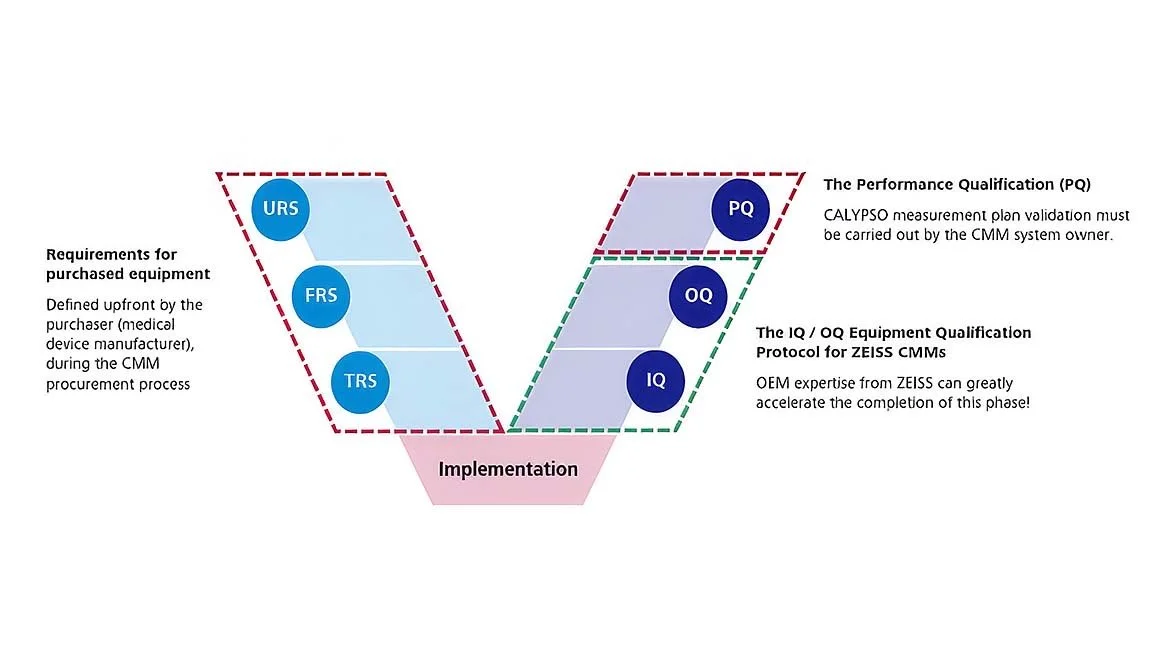
An OEM-designed IQ/OQ protocol can support the manufacturer’s validation efforts by providing structured documentation relevant to the system’s installation and operational characteristics. Source: ZEISS Industrial Quality Solutions
Measurement Program Validation
An IQ/OQ protocol, especially one designed and executed by personnel with appropriate expertise and training, can provide documented evidence that a system is installed and operating as intended. However, IQ/OQ alone does not demonstrate that every program created in the metrology software and executed on the metrology system will provide accurate, repeatable and robust results for a specific part or application. Additional methods may be needed to evaluate individual programs and part-specific aspects of the measurement process, such as fixturing, styli, scan strategies and evaluation settings.
GR&R studies: Gage Repeatability and Reproducibility (GR&R) studies are commonly used to evaluate whether a measurement process produces repeatable and reproducible results.
Comparison to calibrated workpieces: Some methods, including GR&R studies, do not fully evaluate measurement accuracy. One approach is to compare program results with those from a calibrated workpiece or reference part measured by a qualified source with appropriate uncertainty.
Correlation with other measurement methods: When other measurement technologies with suitable capabilities are available, they may be used to provide supporting evidence for the results of a measurement process or program.
Documented practices, SOPs and user training: Documented programming practices, fixturing approaches, scanning strategies, evaluation settings and user training can help improve consistency, especially when part variety is high.
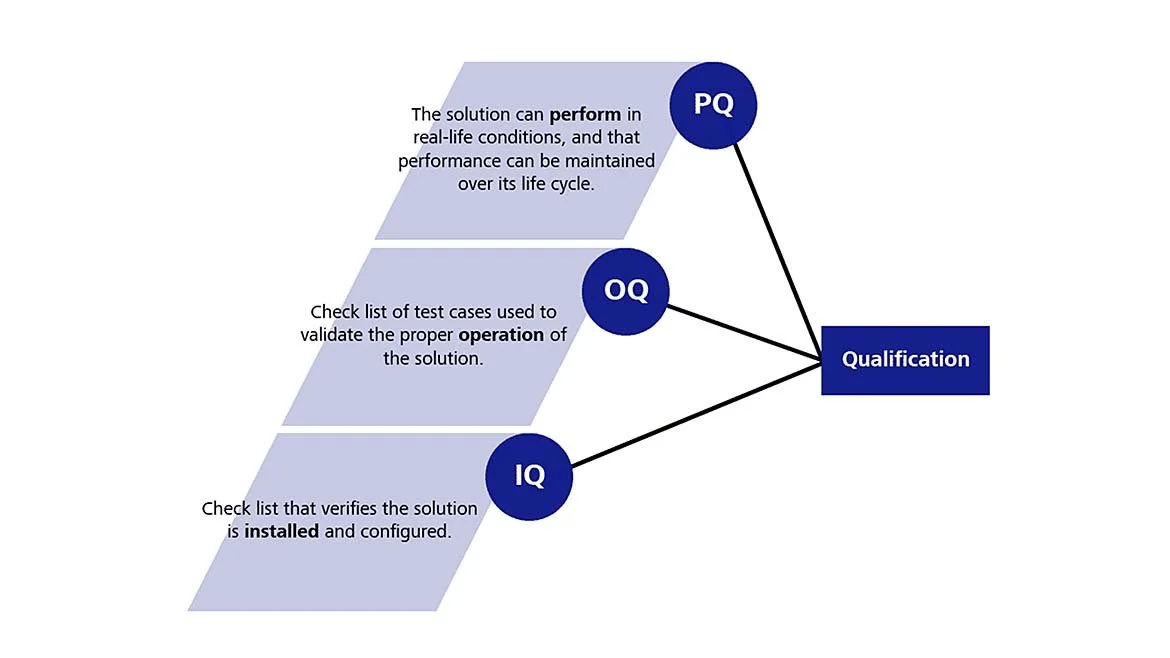
IQ/OQ equipment qualification protocols are widely used to document that purchased systems are installed and operating as intended within defined conditions. Source: ZEISS Industrial Quality Solutions
In summary, IQ/OQ equipment qualification protocols are widely used to document that purchased systems are installed and operating as intended within defined conditions. For medical device manufacturers, these protocols may help support quality system documentation for equipment used to manufacture, package, inspect, or measure medical devices.
IQ/OQ protocols for CMMs or XCT systems can assess general hardware and software functionality, but they do not, by themselves, establish that every program created or executed on a CMM or XCT system is accurate, reliable or repeatable for its intended use. Other methods, such as GR&R studies, calibrated workpiece comparisons or correlation activities, may be used to evaluate individual programs and part-specific aspects of the measurement process, including styli, fixturing, and evaluation settings.
FDA regulations generally do not explicitly require or describe the use of these specific practices for metrology systems or metrology software. Each medical device manufacturer is responsible for determining the validation activities required by its quality system, intended use, and risk profile. IQ/OQ protocols, GR&R studies and other documented methods can help support that determination by providing evidence intended to demonstrate that CMM or XCT-based inspections of medical device components are capable of producing trustworthy results.
This article is provided for informational purposes only and does not constitute legal, regulatory or compliance advice. Manufacturers may wish to consult their quality, regulatory and validation teams when determining requirements applicable to their specific products, processes and quality systems. References to specific regulations and standards reflect publicly available information as of the date of publication and are subject to change.