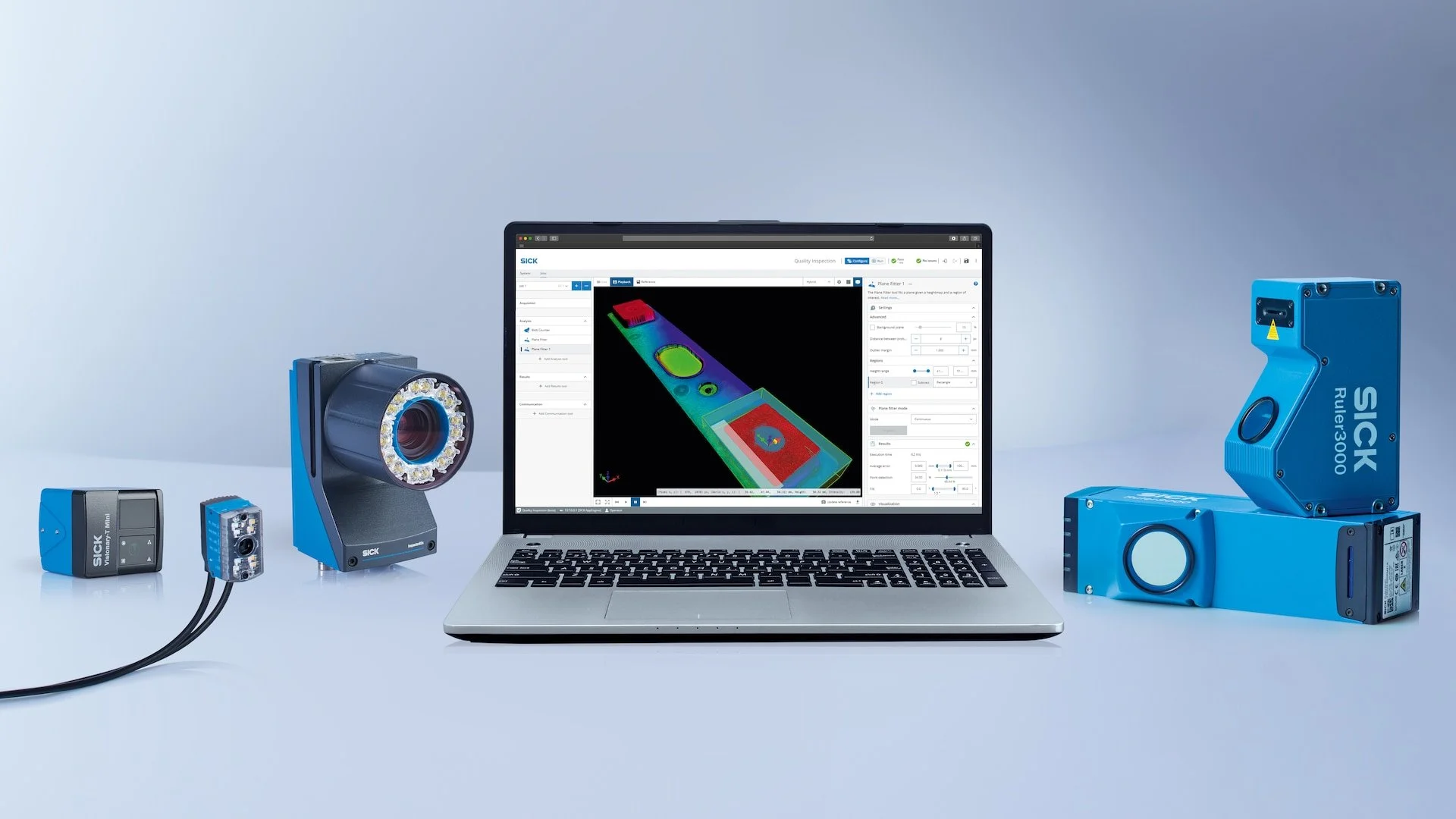
Metrology and quality teams have spent years chasing a specific problem: how do you reliably inspect a part when color, contrast, or surface pattern won’t give you a clean read? SICK’s answer is a significant update to its Nova machine vision platform, which now extends AI-powered deep learning tools into the third dimension — letting inspection systems reason about the actual height, volume, pose, and shape of a part rather than just its 2D appearance.
What’s New: AI Meets Height Data
Nova has offered AI-based deep learning tools for 2D inspection for some time, letting users teach a vision sensor to recognize defects, classify parts, or detect objects simply by showing it examples — no manual rule-writing and no specialist programming background required (SICK). The new development, introduced as “AI for 3D” starting with Nova version 2.15 and expanded through version 2.17, brings that same example-based approach to height data captured by SICK’s 3D vision sensors.
In practical terms, this means AI Anomaly Detection, AI Classification, and AI Object Detection can now train and run on height information instead of, or alongside, standard intensity data. Rather than analyzing a flat, grayscale-style image, the AI model can evaluate the true three-dimensional geometry of an object — its elevation, contours, and volume — to spot subtle defects or classify parts.
Why It Matters for Metrology Teams
For anyone who has struggled to get a consistent 2D vision read on a part because of glare, low contrast, reflective surfaces, or printed patterns that confuse a camera, height-based AI inspection removes that variable entirely. According to SICK, height-based inspection “enables reliable evaluation independent of print or color variations, preventing false detections and enabling fast, effortless batch changes”.
That combination — AI’s flexibility with 3D data’s objectivity — is what SICK describes as unlocking “advanced quality control applications once difficult or impossible to achieve” (SICK). For CMM and inspection professionals, this class of tool complements rather than replaces high-precision coordinate measurement: while a CMM delivers certified dimensional accuracy for validation and reporting, AI-driven 3D vision on the production line can perform rapid, in-process screening at speeds no CMM can match, flagging anomalies before parts ever reach a measurement lab.
How It Works
The setup philosophy stays consistent with the rest of the Nova platform: teach by example, not by rule. Users present the system with sample images of “good” parts (and, for tools like AI Anomaly Detection, optionally “bad” ones), and the model trains directly on the device — no cloud dependency, no additional computing hardware, and no need for deep learning expertise. SICK notes that on-device training supports up to 100 images for tools such as AI Anomaly Detection and AI Classification, while more demanding projects can be scaled using the SICK dStudio cloud service for larger datasets, collaborative annotation, and neural network optimization.
The AI for 3D tools run on SICK’s existing 3D hardware lineup through Nova’s hardware-specific SensorApps, including the Ruler3000 high-speed 3D streaming camera, the Visionary-T Mini AP snapshot camera, and the Visionary-S AP stereo camera — meaning manufacturers already using compatible SICK 3D sensors can adopt the new AI capability without a hardware overhaul.
Target Applications
SICK positions the technology for industries where product variation is inherent and traditional rule-based vision hits its limits, including automotive, battery manufacturing, electronics, logistics, and consumer goods production. Explicitly cited use cases span surface inspection, weld-seam inspection, adhesive-bead inspection, soldered-piece inspection, and injection mold tool inspection — tasks where identifying “true defects from normal variation” has historically required a trained human eye.
The Bigger Picture
This release continues a multi-year push by SICK to make advanced AI-based inspection accessible to non-specialists — first bringing deep learning tools to 2D sensors, then extending the Intelligent Inspection toolset license to 3D devices, and now adding true height-aware AI analysis (SICK). For CMM programmers and quality engineers already comfortable customizing inspection reports and workflows, the direction is notable: AI-driven 3D vision is increasingly positioned not as a replacement for precision metrology, but as a fast, adaptable front line that can catch defects and variation earlier in the process, feeding cleaner parts downstream to full dimensional verification.
Source: www.sick.com