By Sam Jagger
In the field of dimensional metrology, standards like the Dimensional Measuring Interface Standard (DMIS) and the Quality Information Framework (QIF) play crucial roles in ensuring interoperability, data integrity, and efficiency in manufacturing processes. While both are maintained by the Digital Metrology Standards Consortium (DMSC), they serve different purposes and have evolved to meet the demands of modern digital manufacturing. This article provides a detailed comparison, highlighting their history, formats, uses, advantages, disadvantages, and interoperability.
History
DMIS originated as a standard for programming Coordinate Measuring Machines (CMMs) and has been an established ANSI/ISO standard (ISO 22093) since its early versions. The latest version, DMIS 5.3, includes updates for better harmonization with newer standards. Developed in the 1980s, DMIS addressed the need for a common language to control dimensional measuring equipment across different vendors.
QIF, on the other hand, is a more recent development by the DMSC, approved as ISO 23952:2020 in 2020. It emerged to support Model-Based Enterprise (MBE) initiatives and digital metrology, building on lessons from legacy standards like DMIS to enable broader data exchange throughout the product lifecycle.
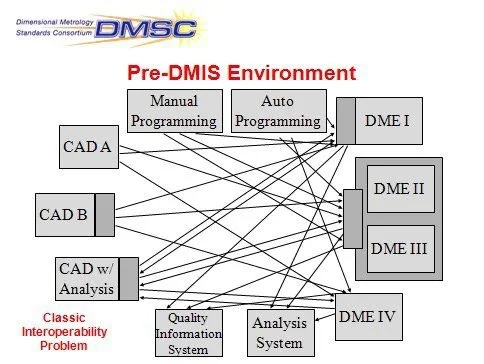
Historical timeline leading to DMIS, illustrating the evolution of metrology standards.
Format and Structure
DMIS is essentially a programming language with both input (for defining measurements and tolerances) and output (for results and logs) components. It uses a text-based syntax to describe features, operations, and equipment control.
QIF employs an XML-based framework with modular schemas (e.g., QIFPlans.xsd, QIFResults.xsd) that define structured data elements like features, characteristics, and metadata. This allows for validation, extensibility, and semantic linking, making it more adaptable to digital environments.
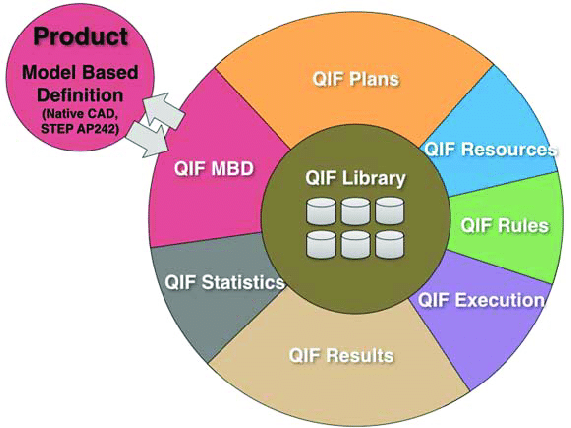
Diagram representing the modular structure of QIF schemas and supporting libraries. - Source - sciencedirect.com
Uses and Applications
DMIS is primarily used for creating measurement programs for CMMs and other inspection devices, facilitating communication between CAD systems, measurement software, and hardware. It’s focused on execution-level tasks, such as defining probe paths and reporting deviations.
QIF extends beyond measurement to encompass the entire quality information lifecycle, including measurement plans, results, statistics, and integration with Product Lifecycle Management (PLM) and Product Data Management (PDM). It’s ideal for Model-Based Definition (MBD), supply chain data exchange, and digital twin applications.
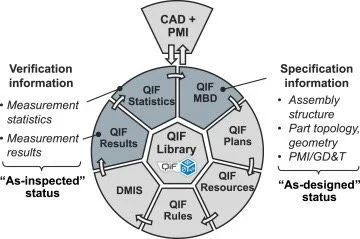
Illustration of QIF integration in the digital thread for metrology processes. Source - sciencedirect.com
Advantages and Disadvantages
DMIS Advantages: As an established ISO standard, DMIS offers proven interoperability for CMM programming across vendors, reducing setup times and ensuring consistent measurement execution. It’s straightforward for legacy systems.
DMIS Disadvantages: It’s limited to measurement control and lacks comprehensive support for upstream (design) or downstream (analysis) processes, making it less suitable for full digital integration.
QIF Advantages: QIF’s XML structure enables easy data validation, traceability to MBD, and modular reusability, supporting Industry 4.0 initiatives like real-time analytics and supply chain collaboration. It’s free to implement and semantically rich.
QIF Disadvantages: Adoption may require new tools and training, and as a newer standard, it might not yet be universally supported in all legacy equipment.
Interoperability and Relationship
DMIS and QIF are designed to complement each other. While DMIS is not embedded in QIF, the latest DMIS 5.3 incorporates UUIDs for traceability, aligning with QIF mechanisms. QIF explicitly references DMIS elements (e.g., feature types) without duplication, allowing seamless integration in metrology workflows. For instance, QIF can use DMIS for equipment control while handling broader data exchange. This harmony supports transitions from DMIS-based systems to QIF-enabled digital ecosystems.
Conclusion
DMIS remains a foundational standard for CMM programming, while QIF represents the future of integrated, digital metrology with its expansive framework. Organizations should consider hybrid approaches, leveraging DMIS for execution and QIF for end-to-end quality management, to maximize efficiency in modern manufacturing. For more details, refer to resources from the DMSC and NIST.
Sources
QIF Overview (NIST PDF): https://www.nist.gov/document/2024-mbe-summit-qif-campbell-qif-overview - Compares QIF with DMIS, noting harmonization in DMIS 5.3.
The Ultimate Guide to QIF (Discus Software): https://www.discussoftware.com/news/the-ultimate-guide-to-qif/ - Guide highlighting QIF’s advantages over legacy standards like DMIS in digital metrology.
Data Models to Support Metrology (UNC Charlotte PDF): https://ninercommons.charlotte.edu/record/874/files/Heysiattalab_uncc_0694D_11503.pdf - Discusses QIF’s consistency with DMIS and explicit use of DMIS elements.
Decoding Metrology Buzzwords: QIF (YouTube Video): https://www.youtube.com/watch?v=wRjkFxhQ5ew - Explains QIF’s benefits in reducing programming time compared to traditional standards.
About QIF Report (Hexagon Nexus): https://nexus.hexagon.com/documentationcenter/en-US/bundle/pcdmis-2025.1-core/page/reporting/About_QIF_Report.htm - Integration of QIF with tools like PC-DMIS.
Quality Information Framework – Integrating Metrology Processes (ScienceDirect): https://www.sciencedirect.com/science/article/abs/pii/S1474667016333316 - QIF’s modular approach for closing metrology loops, with DMSC involvement.
Quality Information Framework – Integrating Metrology Processes (NIST PDF): https://tsapps.nist.gov/publication/get_pdf.cfm?pub_id=910396 - Comparison of feature types between QIF and DMIS 5.2.
What’s Next for QIF? It’s QIF 4.0 (Action Engineering): https://www.action-engineering.com/blog/whats-next-for-qif-its-qif-4-0/ - Evolution from DMIS implementations to QIF 4.0.
These sources provide comprehensive, up-to-date information as of the current date (December 11, 2025). For the most current developments, visit the DMSC website directly. If you need details from a specific source or additional searches, let me know!

