As ISO 9001 moves into its 2026 revision, many CMM programmers and metrology leaders are asking a practical question: What actually changes, and how will it affect our day-to-day work in inspection, programming, and quality systems?
The good news is that ISO 9001:2026 is an evolution, not a revolution. The changes are moderate and focused on clarity, leadership accountability, ethical quality culture, better risk and opportunity thinking, and the growing role of reliable data and digital tools. For professionals working with CMMs, GD&T, measurement uncertainty, and precision inspection, several updates have direct relevance.
This article breaks down the key changes and explains exactly what CMM programmers and metrology leaders need to know now to prepare.
Publication Status (as of July 2026):
The Final Draft International Standard (FDIS) has been released. Official publication is expected in September 2026, with a standard three-year transition period for certified organizations.
Key Changes in ISO 9001:2026
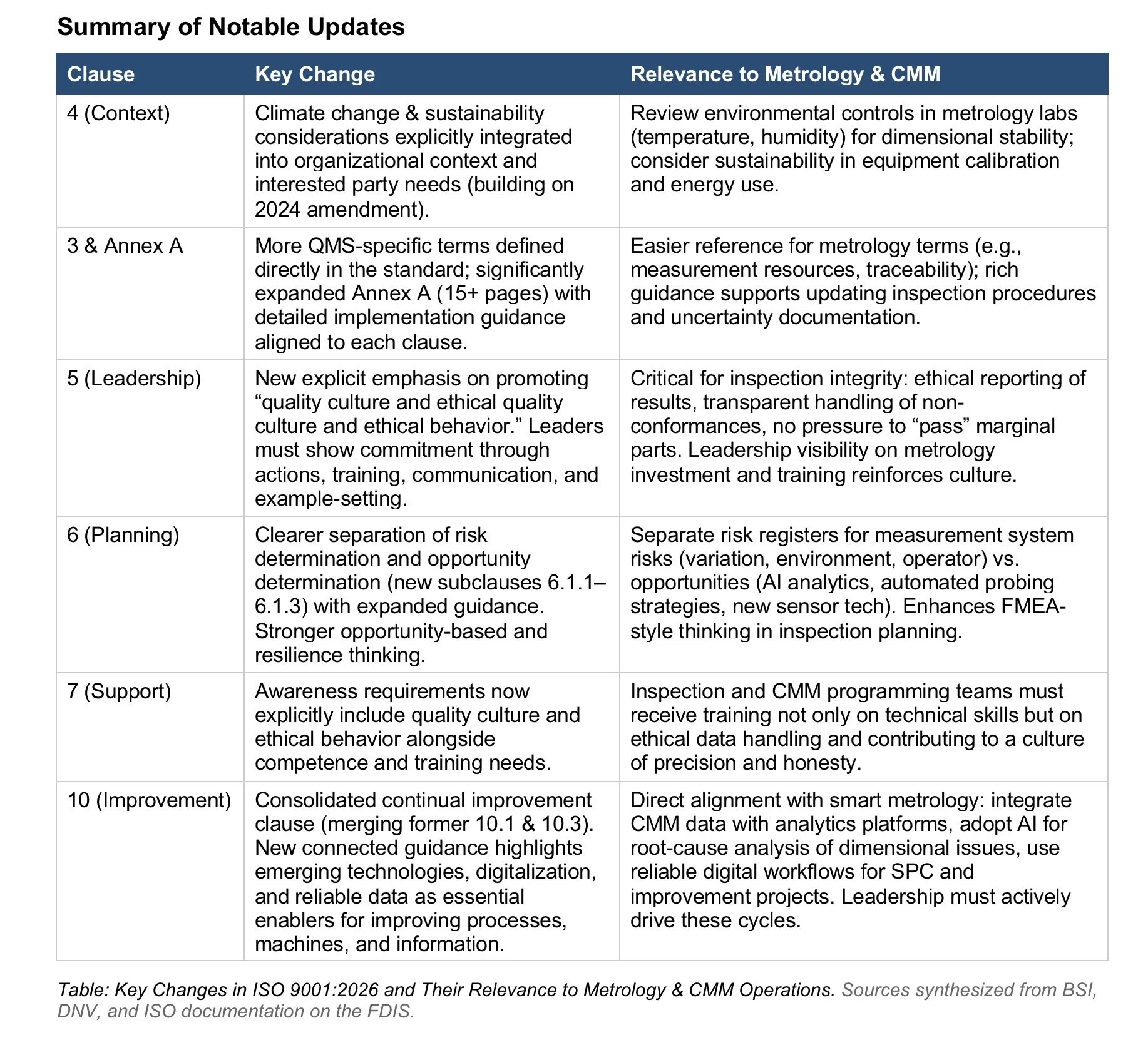
While the overall structure remains based on Annex SL, several meaningful refinements have been introduced. Here is a clear summary of the most relevant updates:
Implications for CMM Programmers and Metrology Leaders
Reliable Data and Digital Tools
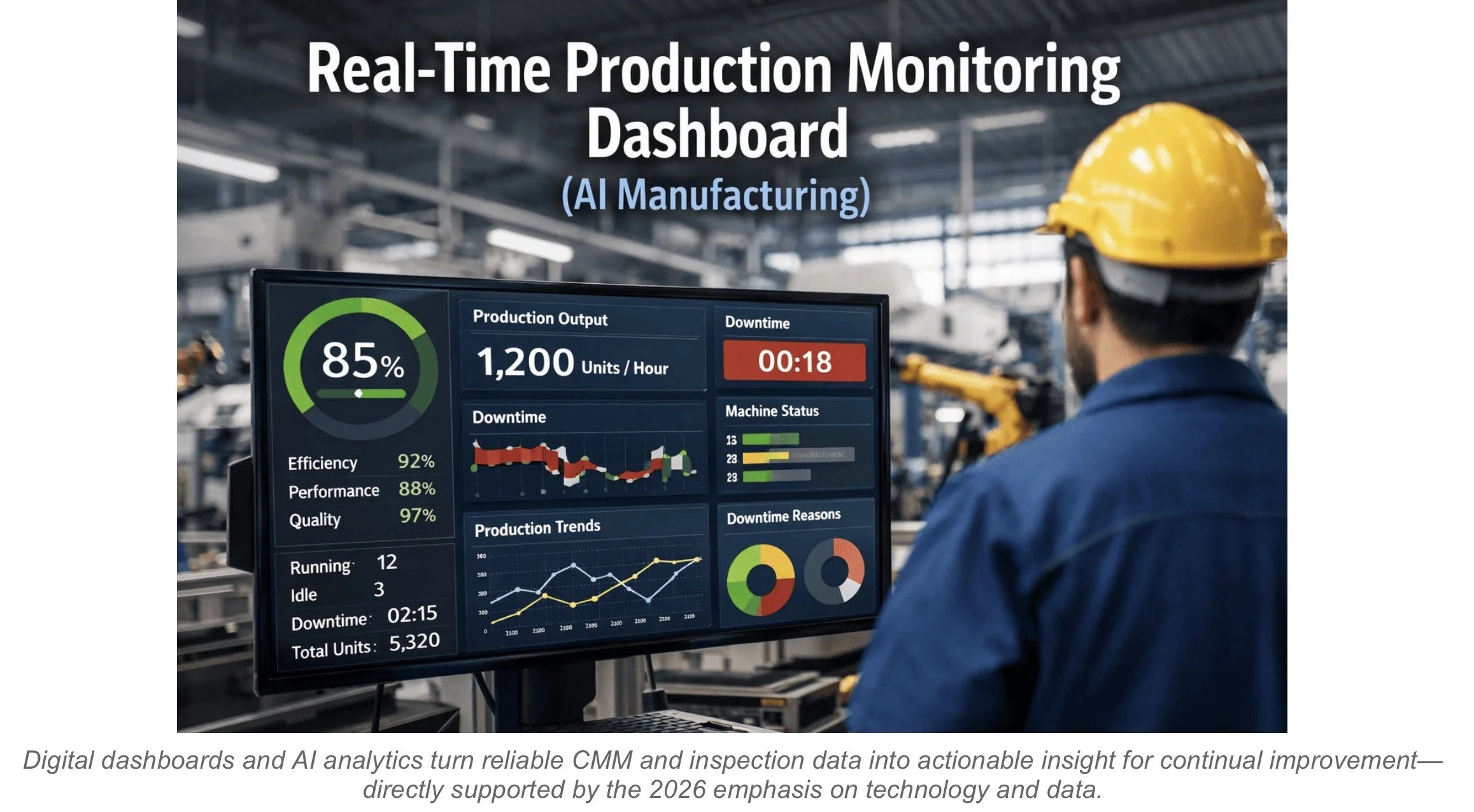
The standard now places greater emphasis on reliable data as a foundation for continual improvement. CMM reports and dimensional data are central to this. Organizations will be expected to ensure data integrity, traceability, and effective use in decision-making. This supports greater integration of CMM output with QMS, MES, SPC, and analytics platforms.
Risk and Opportunity Thinking in Measurement
The clearer separation of risks and opportunities is useful for metrology teams. You can now more explicitly document measurement risks (such as environmental factors, probing strategies, or fixture variation) while also capturing opportunities (such as automated inspection cells, offline programming, or AI-assisted root cause analysis).
Climate considerations may also prompt a fresh look at laboratory environmental controls, which directly affect dimensional stability.
Quality Culture and Ethical Behaviour
One of the most notable additions is the focus on quality culture and ethical behaviour under leadership. In precision manufacturing, this directly relates to honest reporting of results, proper handling of borderline parts, and creating an environment where inspectors and programmers can raise concerns without pressure.
This aligns closely with long-standing metrology values of integrity and accuracy.
Image Placeholder:
Diverse leadership team in a professional meeting discussing quality and strategy. Suggested caption: “Leadership commitment to quality culture and ethical behaviour is now explicitly required.”
Digitalization and Software Considerations
While the standard does not prescribe specific technologies, the guidance around digitalization and reliable data creates positive momentum for modern metrology workflows. Expect increased attention to how CMM software is validated, how programs are controlled, and how inspection data flows securely into broader quality systems.

How to Prepare: Practical Steps for Metrology Teams
Here are targeted actions CMM programmers and metrology leaders can take now:
Perform a focused gap analysis — Review your current QMS against the key areas above (especially Clauses 4, 5, 6, 7, and 10), with particular attention to measurement processes and data workflows.
Strengthen quality culture in inspection — Update awareness training to include ethical data handling and professional integrity. Make leadership expectations visible.
Review environmental controls — Assess temperature, humidity, and vibration monitoring in inspection areas and link them to both quality and sustainability objectives.
Update risk and opportunity registers — Clearly separate measurement risks from opportunities (new technology, automation, analytics) and connect them to improvement activities.
Evaluate data integrity and digital workflows — Audit how CMM data is captured, stored, validated, and used for improvement. Identify opportunities to improve traceability and accessibility.
Engage leadership — Brief management on the new expectations around quality culture and the strategic value of reliable metrology data.
Final Thoughts
ISO 9001:2026 reinforces many of the principles that strong metrology teams already practice: integrity in measurement, the value of reliable data, and the importance of leadership support. The changes give clearer language and stronger expectations around culture, digital enablement, and opportunity-driven thinking.
For CMM programmers and metrology leaders, this is an opportunity to elevate the role of dimensional quality within the broader quality management system — moving from compliance-focused activities to strategic contributors in data-driven improvement.
Start preparing now. The transition timeline is generous, but organizations that act early will gain the clearest advantage.
References
ISO. ISO 9001:2026 – Quality management systems — Requirements (under publication, expected September 2026).
https://www.iso.org/standard/88464.htmlBSI Group. ISO 9001:2026 – Key Changes and Guidance.
https://www.bsigroup.com/en-US/products-and-services/standards-services/iso-9001-2026-key-changes-and-guidance/DNV. ISO 9001:2026 Revision: Changes & Transition.
https://www.dnv.us/assurance/Management-Systems/new-iso/transition/iso-9001-revision/Supporting analysis from Intertek, SGS, NQA, and Quality Magazine summaries of the FDIS (2025–2026).