Introduction
Aircraft canopies, typically made from acrylic or polycarbonate materials, are critical components that provide pilots with unobstructed visibility while maintaining structural integrity under extreme conditions. However, over time, these transparent structures accumulate scratches, abrasions, and surface damage from environmental exposure, bird strikes, and operational wear. Traditional maintenance involves labor-intensive manual sanding and polishing, which is not only time-consuming but also prone to inconsistencies that can compromise optical clarity and safety. Enter GrayMatter Robotics, a pioneer in AI-powered robotic solutions, whose innovative use of 3D sensing and AI adaptive robot control is revolutionizing this process. By automating precision tasks, GrayMatter’s technology addresses longstanding challenges in aviation maintenance, repair, and overhaul (MRO), enhancing efficiency, safety, and mission readiness.

The Challenges in Aircraft Canopy Maintenance
Maintaining aircraft canopies is one of the most demanding tasks in aerospace MRO. Manual processes require skilled technicians to meticulously remove defects without over-sanding, which could distort the canopy’s shape or reduce its thickness beyond safe limits. This work is ergonomically challenging, often leading to repetitive strain injuries, and can take hours or days per canopy. Variability in human performance also results in rework, increasing downtime for critical aircraft like fighter jets. According to industry insights, labor shortages exacerbate these issues, with aviation facing a projected deficit of skilled workers. GrayMatter Robotics recognizes these pain points, noting that “manual canopy repair is one of the most demanding precision tasks in aircraft maintenance, requiring exceptional skill and consuming valuable technician hours.”
In response, GrayMatter has developed systems that leverage advanced robotics to transform these operations, particularly through their Smart Robotic Canopy Sanding System, funded by a Phase II contract from AFWERX, the innovation arm of the U.S. Department of the Air Force. This initiative targets maintenance for acrylic and polycarbonate parts, extending service life and reducing turnaround times.
The Role of 3D Sensing in Precision Maintenance
At the heart of GrayMatter’s approach is advanced 3D sensing technology, which enables robots to “see” and understand the complex geometries of aircraft canopies. Unlike traditional 2D imaging, 3D sensing captures depth, contours, and surface irregularities with high accuracy, creating a detailed digital map of the canopy. This is crucial for identifying defects such as scratches or pits that might be invisible to the naked eye but could impair visibility.
GrayMatter’s systems integrate 3D sensors to scan parts in real-time, allowing for autonomous defect detection and path planning. For instance, their SCAN&SAND™ solution uses 3D vision to self-program toolpaths without the need for CAD models or manual coding. This eliminates the weeks-long programming required in conventional robotics, reducing setup to mere minutes. In canopy maintenance, 3D sensing ensures that the robot adapts to curved surfaces and varying thicknesses, preserving optical properties while removing only the necessary material.
AI Adaptive Robot Control: The Brain Behind the Operation
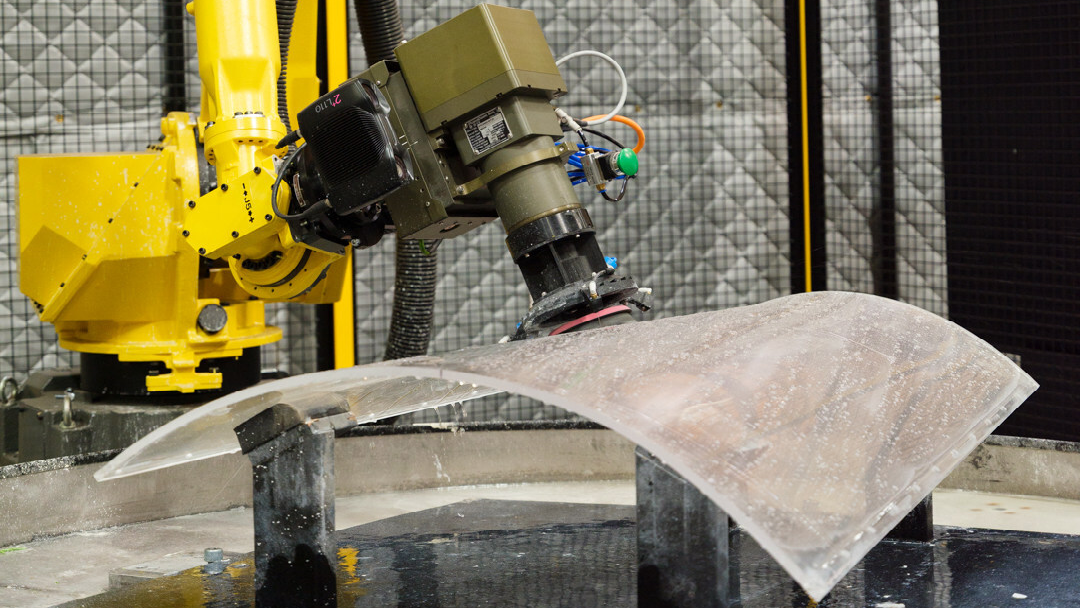
Complementing 3D sensing is GrayMatter’s proprietary GMR-AI™ platform, which powers adaptive robot control. This physics-informed AI uses machine learning to interpret sensor data, generate trajectories, and adjust in real-time to variables like material inconsistencies or environmental factors. Force-adaptive control is a key feature, allowing the robot to apply precise pressure during sanding—too much could damage the canopy, too little would leave defects intact.
In aviation MRO, where parts exhibit high variability, this adaptability is transformative. As noted by a GrayMatter Robotics engineer, “The technology adapts in real time to maintain precision, even with small part-to-part differences.” The system autonomously identifies and removes surface defects on both interior and exterior surfaces, ensuring consistent results that meet stringent compliance standards like those from the FAA or military specifications. By integrating AI with robotic arms, GrayMatter’s solution handles high-mix operations, making it ideal for diverse aircraft models without custom fixturing.
GrayMatter Robotics’ Integrated Solution
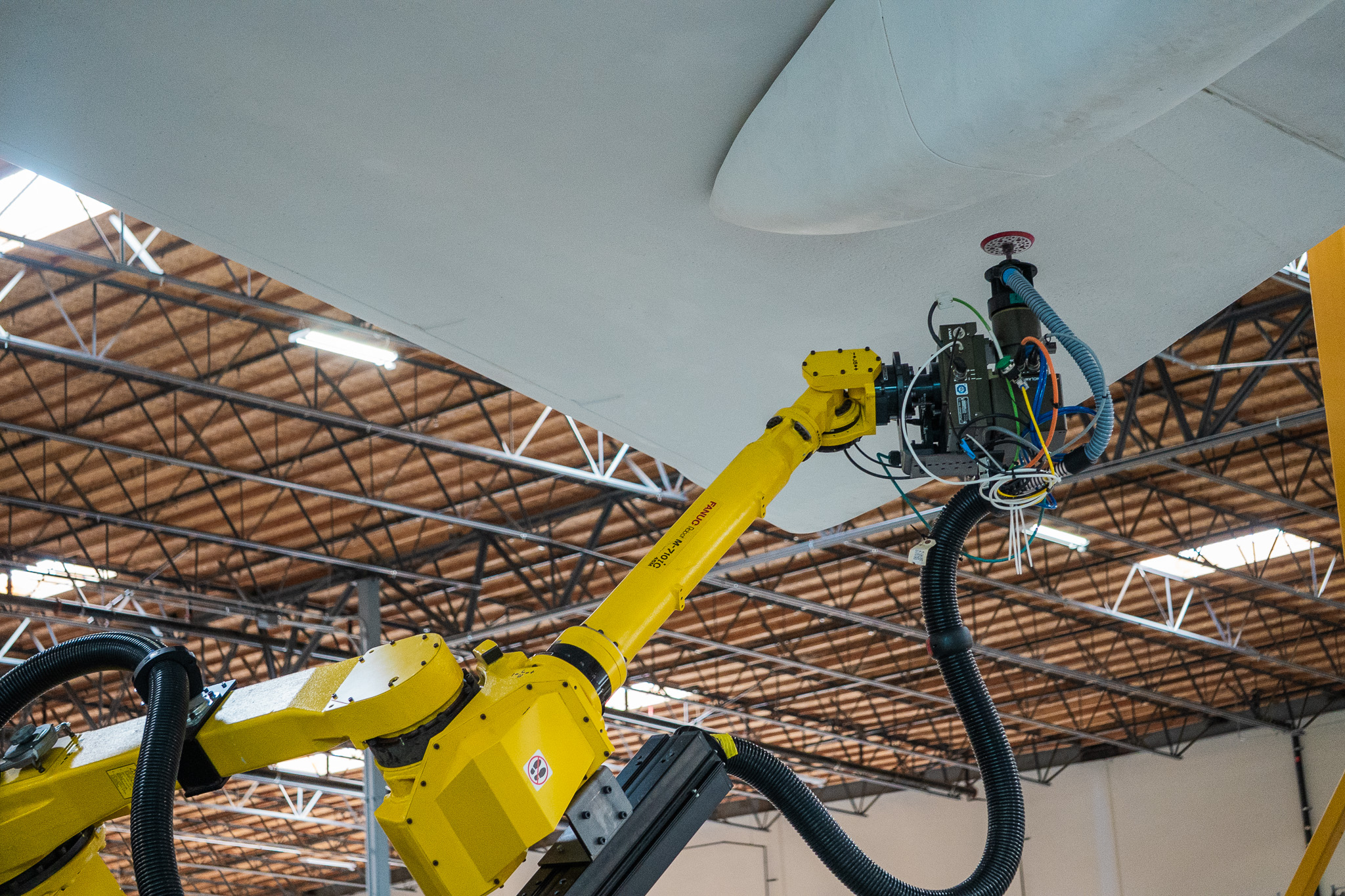
GrayMatter’s Smart Robotic Canopy Sanding System exemplifies the synergy of 3D sensing and AI adaptive control. Awarded under the AFWERX SBIR Phase II contract, this system builds on GrayMatter’s expertise in surface finishing robotics. It scans the canopy, detects anomalies, and executes a customized sanding process that restores optical clarity and structural integrity.
Key features include:
Autonomous Trajectory Generation: AI creates optimal paths based on 3D scans, adapting to complex shapes.
Force-Adaptive Control: Real-time adjustments ensure uniform material removal.
Defect Detection and Removal: Systematic elimination of scratches while minimizing waste.
User-Friendly Interface: No coding required; operators can deploy the system with minimal training.
This technology is part of GrayMatter’s broader portfolio, including SCAN&INSPECT™ for dimensional checks and SCAN&BLAST™ for abrasive processes, all tailored for aerospace applications.
Benefits and Process Improvements
The adoption of GrayMatter’s robotics yields significant advantages:
Efficiency Gains: Reduces sanding time by 2-4x compared to manual methods, boosting throughput.
Safety Enhancements: Eliminates ergonomic risks, allowing technicians to focus on high-value tasks.
Quality Consistency: Achieves defect-free finishes with 30-50% less consumable usage, reducing scrap and rework.
Cost Savings: Through Robots on Demand model, organizations avoid large capital expenditures.
Mission Readiness: Faster maintenance cycles ensure aircraft return to service quicker, critical for defense operations.
Metrics from GrayMatter’s implementations show training reduced from months to a single day, with machine learning enabling continuous performance upgrades.
Case Studies and Real-World Applications
While specific case studies for canopy maintenance are emerging from the AFWERX contract, GrayMatter’s technology has proven effective in similar aerospace tasks. For example, in high-mix MRO environments, their systems have doubled output in surface finishing for aircraft parts. The DoD has recognized GrayMatter as a finalist in challenges addressing maintenance workforce shortages, validating their approach for weapon systems like fighter aircraft.
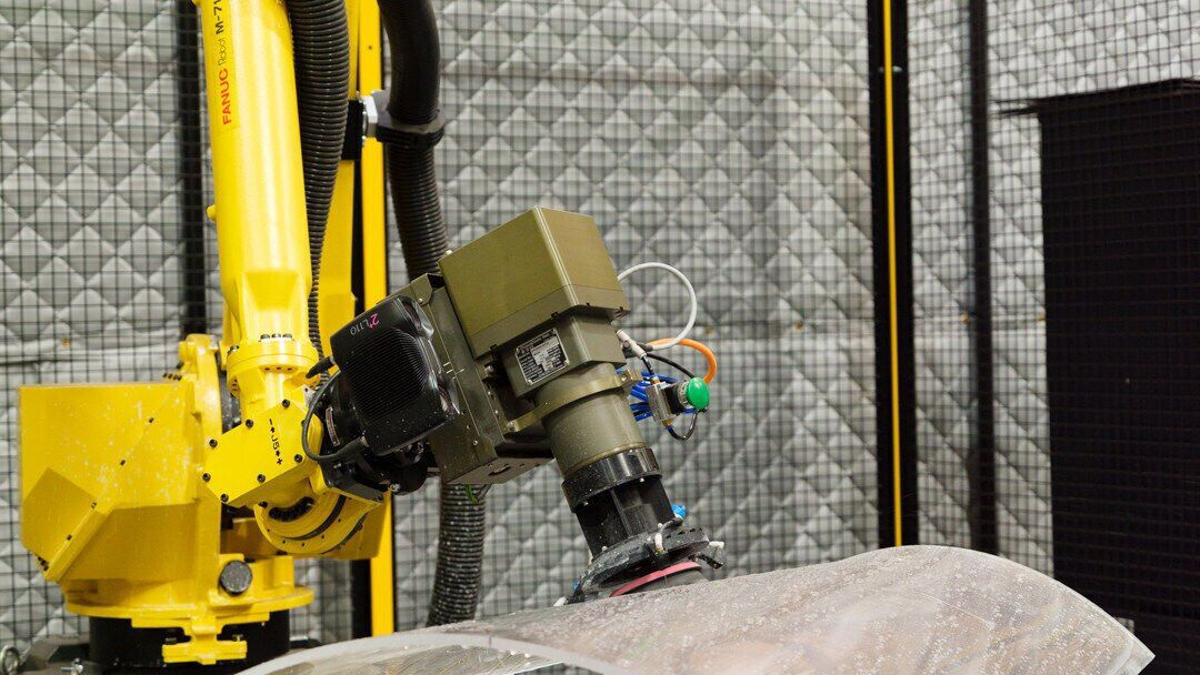
In one aviation MRO deployment, robots handled sanding of large, curved components, adapting to variations without downtime. This mirrors the canopy process, where precision is paramount to avoid optical distortions.
Future Implications
As aviation evolves with increasing demands for sustainability and efficiency, GrayMatter’s innovations set a benchmark. Future developments may expand to other transparent components or integrate with augmented reality for hybrid human-robot workflows. With ongoing machine learning upgrades, these systems will become even more intelligent, potentially predicting maintenance needs before defects arise.
Conclusion
GrayMatter Robotics is at the forefront of advancing aircraft canopy maintenance through 3D sensing and AI adaptive robot control. By automating what was once a manual, error-prone process, their solutions not only enhance operational efficiency but also safeguard the well-being of maintenance teams. As the aerospace industry grapples with labor challenges and rising complexities, technologies like GMR-AI™ promise a future where robots empower humans to achieve unprecedented precision and productivity.

